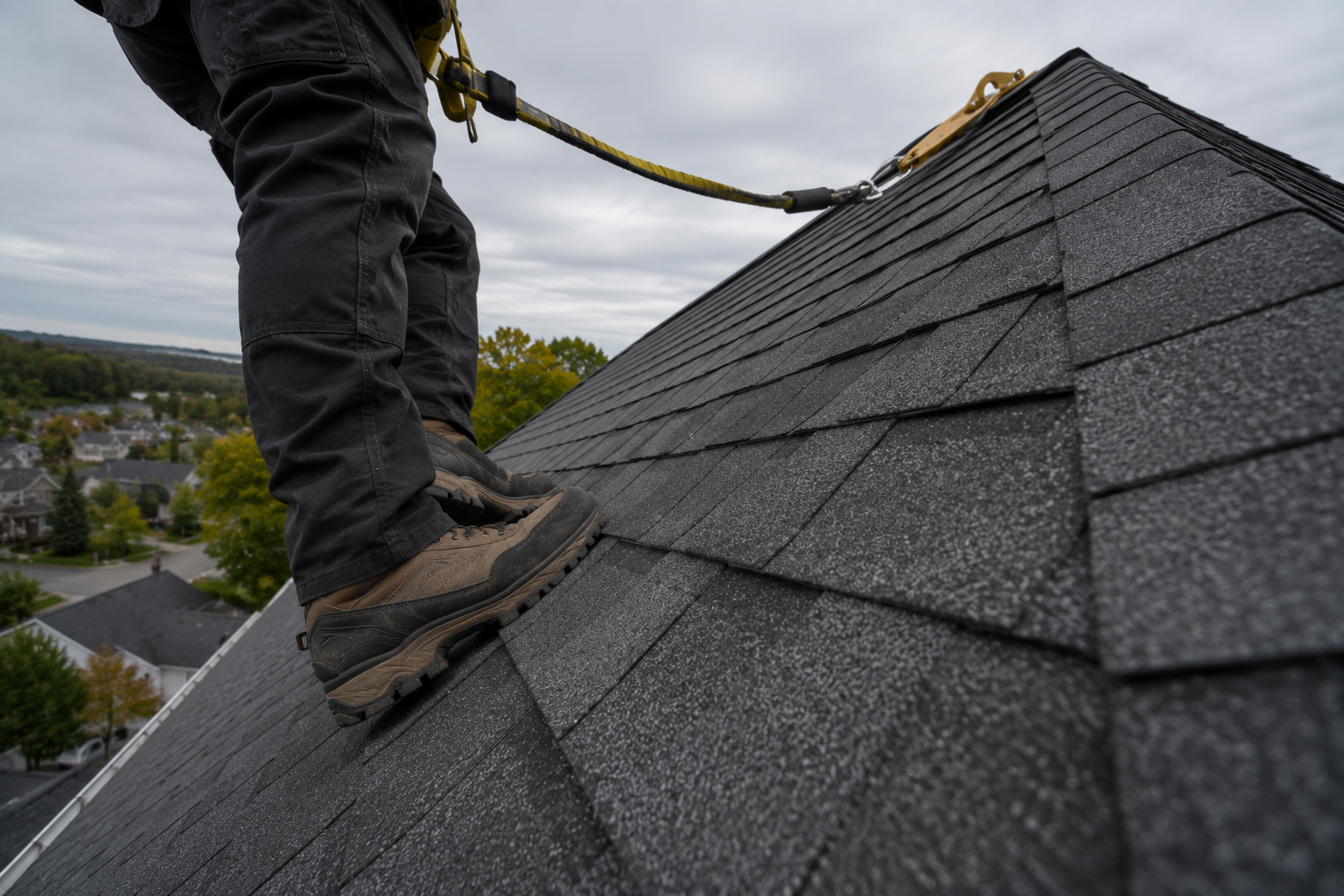
What Pitch Is Too Steep to Walk On? (And How to Stay Safe)
The short answer: most roofing professionals consider 7/12 (30.3°) the upper limit of comfortable unaided walking, and treat anything above 9/12 (36.9°) as a pitch that cannot be safely walked without mechanical support — roof jacks, scaffolding, or a crawling board at minimum. Above 12/12 (45°), no one should set foot on the surface without a full fall arrest system and rigging setup.
But "too steep to walk on" is not a single threshold — it's a sliding scale that depends on four things: the pitch itself, the surface condition, your footwear, and the fall protection you have in place. This guide gives you the practical numbers for each scenario so you can make a clear-eyed assessment before anyone goes up.
📐 Don't know your exact pitch? Find out from the attic — safely.
The free Pitch Gauge tool reads any roof slope in seconds using your phone's gyroscope — no roof access required.
The Quick Reference: Walkability by Pitch
| Pitch | Degrees | Walkability verdict | Minimum safe approach |
|---|---|---|---|
| Up to 4/12 | Up to 18.4° | Easy — feels nearly flat | PFAS required above 6 ft (OSHA); edge awareness critical |
| 5/12 – 6/12 | 22.6° – 26.6° | Walkable with care — upper limit for most people | PFAS required; good rubber-soled footwear; dry conditions only |
| 7/12 – 8/12 | 30.3° – 33.7° | Steep — uncomfortable without support | PFAS plus roof jacks for any extended work |
| 9/12 – 10/12 | 36.9° – 39.8° | Very steep — not walkable without mechanical support | PFAS plus roof jacks or scaffolding required |
| 11/12 – 12/12 | 42.5° – 45.0° | Cannot be walked — scaffolding required | Full scaffolding plus PFAS; treat as high-angle access |
| Above 12/12 | Above 45° | Extreme — do not access without full rigging | Full fall arrest rigging; specialist access only |
For degree and gradient equivalents of every pitch in this table, see the full roof pitch reference chart. If you need to convert your pitch to degrees before looking it up, use the pitch converter.
Why 7/12 Is the Practical "Walkability" Line
At 6/12 (26.6°), an experienced roofer in rubber-soled boots can walk across a dry asphalt shingle surface without mechanical assistance — carefully, with attention to foot placement, but without fighting the slope. The surface still feels close to horizontal instinct.
At 7/12 (30.3°), that changes. The slope is now steep enough that your body is visibly leaning forward relative to the surface, your calf muscles are continuously engaged to maintain position, and any distraction — a tool bag, a glance down at the job — reduces your stability meaningfully. Most experienced roofers will work a 7/12 without roof jacks for short repositioning movements, but not for sustained installation work. It's the practical threshold, even if it isn't a regulatory hard line.
At 9/12 (36.9°), standing unsupported on the surface requires active muscular effort and concentration. A slip at this pitch accelerates the worker down the slope very quickly — there is almost no time to self-arrest before reaching the eave. This is where roof jacks stop being optional and start being the only sensible approach for any work position that lasts more than a few seconds.
💡 The number that matters most: The pitch tells you how likely a slip is. The height tells you the consequence. A 4/12 roof at 20 feet is far more dangerous than a 9/12 roof at 8 feet — even though the higher pitch feels scarier. Always assess both slope and height before deciding on your safety approach.
What Changes the "Too Steep" Threshold
Surface material
The pitch threshold for safe walking shifts significantly based on what you're walking on:
- Dry asphalt shingles — best traction of any roofing surface; the granule texture grips rubber soles well. The practical walkability limit on dry shingles is around 7/12 for experienced workers.
- Metal panels — smooth surface dramatically reduces traction. A standing seam metal roof that would be walkable at 4/12 on shingles may not be safely walkable at 3/12 on metal. Never walk dry metal above 5/12 without mechanical support.
- Tile (clay or concrete) — the rounded crown of a tile provides very little foot contact area. Step only on the lower edge (the butt) of tiles. Practical limit for unaided walking is 5/12 even on dry tile.
- Slate — hard, smooth, and brittle. Slates break underfoot if you step on the surface rather than the batten. Use crawling boards regardless of pitch.
- Algae or moss growth — biological growth makes any surface dangerously slippery at any pitch. A 2/12 moss-covered roof can be more hazardous than a clean 8/12 shingle roof. Treat before accessing.
Moisture
Wet conditions reduce every threshold by at least two pitch steps. A 6/12 shingle roof that is perfectly safe to walk dry becomes genuinely dangerous when wet — the granules become lubricated rather than grippy. Metal and tile surfaces become extremely hazardous even at very low pitches when wet. The rule is straightforward: do not access a wet roof surface if it can be avoided at any pitch above 3/12. Morning dew is sufficient to make a metal or tile roof as slippery as a wet one.
Footwear
Purpose-made roofing boots with soft rubber soles and a designed tread pattern for granule surfaces extend the practical walkability threshold by about one pitch step compared to standard work boots. Hard-soled boots, worn soles, or contaminated soles (mud, oil, sawdust) reduce the threshold in the same way that moisture does. Check sole condition before every roof access — a sole that looked fine last week may have glazed in the sun or picked up contamination since.
Personal fitness and experience
An experienced roofer who accesses steep roofs regularly has trained balance reflexes that a homeowner does not. This is not an argument for either group to skip fall protection — it's an explanation of why the same pitch feels different to different people. The legal thresholds are the same for everyone. The practical "feels OK" threshold is higher for professionals than for occasional users, which is exactly why homeowners should apply a more conservative limit than contractors do.
The OSHA Line vs the Practical Line
These are two different thresholds and both matter:
| Threshold type | Pitch | What it means |
|---|---|---|
| OSHA fall protection required | 4/12 (18.4°) | Legal minimum — PFAS, guardrail, or safety net required for all roofing workers |
| Roof jacks advisable | 7/12 (30.3°) | Industry standard — roof jacks recommended for extended work at this pitch and above |
| Roof jacks required | 8/12 (33.7°) | Most contractor safety policies mandate roof jacks at this pitch and above |
| Scaffolding advisable | 9/12 (36.9°) | Roof jacks alone are insufficient for sustained work; scaffolding or staging recommended |
| Scaffolding required | 10/12 – 12/12 (39.8° – 45°) | Full scaffolding system required for any sustained roofing work |
| Specialist access only | Above 12/12 (above 45°) | Full high-angle access rigging; not a standard roofing operation |
How to Stay Safe at Any Pitch: The Practical Rules
Know your pitch before you access
You cannot assess the correct safety equipment for a roof you haven't measured. The Pitch Gauge tool gives you a precise reading from inside the attic in seconds — before anyone sets foot on the surface. A roof that looks like 5/12 from the ground may be 7/12 when measured. That one pitch step changes your required equipment entirely.
Never access a wet surface above 3/12
This is the single most effective safety rule for residential roofing. The majority of non-professional roofing falls happen when someone accesses a roof in marginal conditions — damp morning, light drizzle, recent rain — under time pressure. Wait for a dry surface. No job is urgent enough to justify a fall.
PFAS from 4/12, roof jacks from 7/12
These are the two anchor points for your equipment decision. At 4/12 and above, a properly anchored personal fall arrest system is required by OSHA and by basic safety sense. At 7/12 and above, add roof jacks to give yourself a stable work platform. Using both together — not as alternatives — is the correct approach for steep-pitch work.
Never work alone on a steep roof
A PFAS arrests a fall but does not get a suspended worker back onto the roof or to the ground safely. A worker arrested in a harness who cannot self-rescue faces suspension trauma — a potentially fatal condition caused by restricted blood flow — within minutes. Someone must be on the ground able to call emergency services and, if trained, initiate rescue. Never access a steep roof without a second person present and aware.
For homeowners: use the attic measurement instead
Most of the reasons a homeowner goes on a roof — checking the pitch, assessing condition, getting a measurement for an estimate — can be done from inside the attic or from the ground without any roof access at all. The Pitch Gauge reads slope from a rafter; the roof calculator produces a complete material and cost estimate from that reading. There is no reason to physically access the roof for these tasks.
⚠️ The most dangerous roof is the one that feels safe. A 5/12 asphalt shingle roof on a dry day is the scenario where most residential roofing falls happen — not because the pitch is extreme, but because it feels manageable without protection. The fall height from a single-storey eave is enough to cause fatal head injuries regardless of the pitch that preceded it.
📐 Measure your pitch safely — no roof access needed
The free Pitch Gauge reads any roof slope from the attic in seconds. Know your exact pitch, know your safety requirements, and get a material estimate — all before setting foot on the surface.
Frequently Asked Questions
What roof pitch is too steep to walk on?
Most roofing professionals consider 7/12 (30.3°) the upper limit of comfortable unaided walking on dry asphalt shingles with appropriate footwear. At 9/12 (36.9°) and above, the pitch is too steep to stand on without roof jacks or scaffolding. At 12/12 (45°) and above, no one should access the surface without a full scaffolding system and personal fall arrest rigging. These thresholds shift lower for wet surfaces, metal or tile roofing, or anyone without professional roofing experience. Find your pitch in the full roof pitch reference chart and measure it from the attic using the Pitch Gauge tool.
Is a 6/12 roof safe to walk on?
A 6/12 roof (26.6°) is at the upper boundary of what experienced roofers consider walkable under dry conditions with rubber-soled footwear. It is not safe to walk without fall protection — OSHA requires a personal fall arrest system for all work at 4/12 and above. On a wet 6/12 roof, or on metal or tile at 6/12, the answer shifts to "no" — the surface becomes genuinely hazardous. For homeowners without professional roofing experience and fall protection equipment, 6/12 should be treated as off-limits without proper gear.
Can you walk on a 4/12 roof?
Yes — a 4/12 roof (18.4°) is physically easy to walk on under dry conditions. However, OSHA requires fall protection (a personal fall arrest system, guardrail, or safety net) for all roofing work at 4/12 and above when the worker is more than 6 feet above the lower level. The ease of walking at 4/12 is exactly what makes it statistically dangerous — workers frequently omit fall protection on "walkable" roofs and a slip at eave height is just as fatal as one on a steeper roof.
What is the steepest roof pitch you can walk on without equipment?
Without any fall protection equipment at all, no roof pitch is safe to work on professionally — OSHA requires fall protection from 4/12 regardless of how the surface feels underfoot. As a practical physical limit, a healthy adult in appropriate footwear can stand unaided on a dry asphalt shingle surface up to about 7/12 (30.3°) without roof jacks, though sustained work at that angle is tiring and risky. Above 9/12 (36.9°), standing without roof jacks or scaffolding is physically difficult even for experienced roofers in ideal conditions.
Does roof pitch affect how dangerous a fall is?
Pitch affects how likely a fall is — steeper slopes are more slippery and harder to self-arrest on — but the consequence of a fall is determined primarily by the height from the work surface to the lower level, not by the pitch. A fall from a 4/12 eave at 20 feet is as fatal as a fall from a 12/12 surface at the same height. This is why OSHA's fall protection threshold starts at 4/12 regardless of pitch, and why the "it feels walkable" reasoning at moderate pitches is the most dangerous assumption in residential roofing.
How do I find out if my roof is too steep to walk on safely?
Measure the exact pitch first — use the Pitch Gauge tool from inside the attic (hold your phone against a rafter) to get a precise reading without any roof access. Then use the walkability table in this article to determine what equipment is required. If your pitch is 7/12 or above, assume roof jacks are needed at minimum. If it's 9/12 or above, scaffolding is the appropriate approach. If you're a homeowner without professional roofing experience, the practical answer for anything above 6/12 is: hire a contractor.