What Is a Pitch Gauge? Roof vs Thread Pitch Gauges Explained
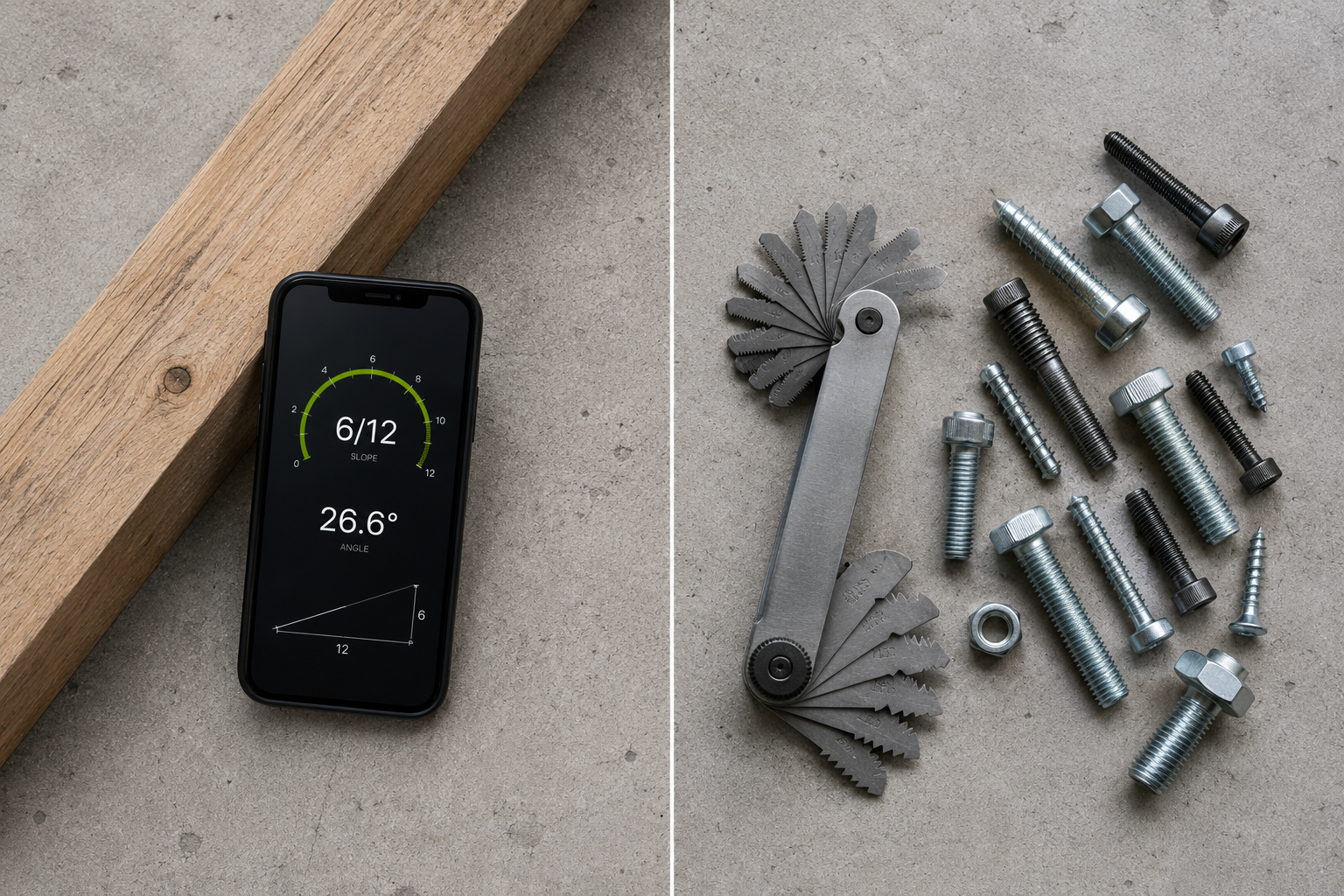
Search for "pitch gauge" and you'll find two completely different tools staring back at you — one used on rooftops, the other in machine shops. They share a name, they both measure something called "pitch," but they have nothing else in common. One tells you how steep a roof is. The other tells you how tightly a screw thread is wound.
If you landed here looking for one and found the other, this article will clear things up fast. We'll explain what each type of pitch gauge is, what it measures, who uses it, and when you need it — so you can find the right tool for your job without wading through irrelevant results.
🏠 Here for the roofing pitch gauge?
Use our free digital pitch gauge tool to measure any roof pitch instantly with your phone — no ladder, no separate hardware required.
📐 Open the Roof Pitch Gauge | 🔢 Calculate Roof Area and Materials
The Two Completely Different Things Called a "Pitch Gauge"
The word "pitch" has two separate meanings in the context of measurement tools:
- In roofing — pitch describes the steepness of a roof, expressed as a ratio of rise to run (e.g. 6/12). A roof pitch gauge measures this angle.
- In engineering and manufacturing — pitch describes the distance between the threads on a screw or bolt, measured in threads per inch (TPI) or millimetres per thread. A thread pitch gauge measures this spacing.
Both tools are called pitch gauges. Both are precision instruments used by professionals. But their applications, industries, and measurement principles are entirely different. Here's a quick side-by-side:
| Feature | Roof pitch gauge | Thread pitch gauge |
|---|---|---|
| What it measures | Roof slope / angle of inclination | Thread spacing on screws and bolts |
| Unit of measurement | X/12 ratio, degrees, or percentage | Threads per inch (TPI) or mm per thread |
| Used by | Roofers, contractors, homeowners | Machinists, mechanics, engineers |
| How it works | Inclinometer / gyroscope or manual | Physical template blades matched to thread |
| Digital version available? | Yes — phone app | Mostly physical; some optical scanners |
| Typical price range | Free (app) to $50 (dedicated tool) | $5 to $80 depending on type and range |
Part 1: The Roof Pitch Gauge
What is a roof pitch gauge?
A roof pitch gauge is a tool that measures the steepness of a roof surface and expresses it as a pitch ratio, angle in degrees, or gradient percentage. It is used primarily by roofing contractors, builders, and homeowners to determine the pitch of an existing roof before ordering materials, planning a repair, checking code compliance, or calculating the actual roof surface area.
Knowing your roof pitch is essential for:
- Calculating how many shingles, tiles, or panels you need (steeper roofs require more material than their footprint suggests)
- Verifying that your chosen roofing material meets the manufacturer's minimum pitch requirement
- Completing permit applications and insurance assessments that require a documented pitch
- Sizing solar panel mounting systems, which are specified by roof angle in degrees
- Estimating labour costs — steeper roofs take longer and require more safety equipment
Types of roof pitch gauge
1. Digital smartphone pitch gauge (app-based)
The most practical and widely used modern option. A pitch gauge app uses the gyroscope and accelerometer already built into your smartphone to measure the angle of any surface it's placed against. Hold your phone flat against a rafter in the attic, a roof panel, or any sloped surface, and the app reads the pitch in real time — displaying the result as an X/12 ratio, degrees, and gradient percentage simultaneously.
The Roof Pitch Gauge on this site works this way. It requires no additional hardware, no ladders, and no roof access if you have a visible rafter in the attic or a sloped ceiling. It also includes a manual input mode for calculating pitch from rise and run measurements.
💡 Best for: Homeowners and contractors who need a quick, accurate reading without specialised hardware. Works from inside the attic — no roof access needed.
2. Mechanical/analogue pitch gauge
A dedicated physical tool, typically a small weighted pendulum housed in a flat body that you place against the roof surface. The pendulum swings to indicate the angle on a printed scale. Accurate and requires no batteries or charging, but you do need to be on or directly adjacent to the roof surface to use it — limiting its convenience compared to a phone app.
3. Speed square with pitch scale
The speed square (or rafter square) is a triangular metal tool that almost every contractor already carries. It has a built-in common pitch scale that gives you the X/12 reading when placed against a rafter or roof surface at the correct angle. Reliable and robust, but requires you to be on the roof or in the attic with direct rafter access. Results are read off a physical scale rather than calculated digitally.
4. Framing square method
A traditional technique using a large L-shaped framing square. Held horizontally against a rafter with a spirit level, you read the rise off the short arm at the 12-inch mark on the long arm. More cumbersome than a speed square but widely available and very accurate. Requires attic access. We cover the step-by-step method in our full guide to measuring roof pitch.
How to read a roof pitch gauge
All roof pitch gauges output the same information in one or more of these three formats:
| Format | Example | What it means |
|---|---|---|
| X/12 ratio | 6/12 | Roof rises 6 inches for every 12 inches of horizontal run |
| Degrees | 26.6° | Angle of inclination from horizontal |
| Gradient / percentage | 50% | Rise as a percentage of run — common in European standards |
All three formats describe the same physical slope. The roof pitch converter switches between all three instantly if your gauge outputs in one format and you need another. For a complete visual reference of every standard pitch with its degree and percentage equivalents, see the pitch reference chart.
What to do with your pitch reading
Once you have your pitch, the next step for most roofing projects is calculating actual roof surface area and material quantities. The roof calculator takes your pitch and plan dimensions, applies the correct pitch multiplier, and outputs roofing squares, material quantities, and a cost estimate — all in one step.
Part 2: The Thread Pitch Gauge
What is a thread pitch gauge?
A thread pitch gauge — also called a screw pitch gauge, thread gauge, or thread form gauge — is a precision measuring tool used to identify the pitch (thread spacing) of a screw, bolt, nut, or threaded hole. It is a standard item in any machine shop, automotive workshop, or engineering environment where fasteners need to be identified, replaced, or matched.
In the context of threads, "pitch" has a very specific technical meaning: it is the distance from one thread crest to the next, measured in millimetres (for metric threads) or expressed as threads per inch (for imperial/unified threads). Getting this wrong when ordering replacement fasteners means the parts won't fit — which is exactly why thread pitch gauges exist.
Why thread pitch matters
Two bolts can look identical — same diameter, same length, same head style — and be completely incompatible with each other if their thread pitch is different. A metric M10 bolt comes in at least three common pitches: 1.5mm (coarse), 1.25mm (fine), and 1.0mm (extra fine). A unified inch bolt at 3/8" diameter comes in 16 TPI (coarse) and 24 TPI (fine). Mixing pitches damages threads and can cause catastrophic fastener failure in high-stress applications.
Thread pitch gauges eliminate guesswork by providing a physical go/no-go check against a known standard.
Types of thread pitch gauge
1. Leaf-type thread pitch gauge (most common)
The standard thread pitch gauge consists of a set of thin metal blades — each one stamped with a specific pitch value — fanned out from a central pivot like a Swiss army knife. Each blade has a precise tooth profile cut into its edge matching a specific thread standard. You press each blade against the threaded fastener until you find the one that fits perfectly — no rocking, no gaps. That blade's value is your thread pitch.
Leaf gauges are inexpensive (typically $5–$25), compact, and require no calibration. They are available in metric (mm pitch values) and imperial (TPI values) versions. Most professional sets cover the full range of standard fastener pitches used in their region.
2. Metric thread pitch gauge
A metric thread pitch gauge is specifically calibrated for ISO metric thread standards — the system used by the vast majority of modern machinery, vehicles, and equipment manufactured outside the United States (and increasingly within it). Pitch values are marked in millimetres — typically ranging from 0.4mm to 3.5mm for the most common fastener sizes.
Common metric pitches you'll encounter:
| Bolt size | Coarse pitch | Fine pitch | Common application |
|---|---|---|---|
| M6 | 1.0mm | 0.75mm | Small machinery, electronics |
| M8 | 1.25mm | 1.0mm | General mechanical assemblies |
| M10 | 1.5mm | 1.25mm | Automotive, structural |
| M12 | 1.75mm | 1.5mm | Heavy machinery, suspension |
| M16 | 2.0mm | 1.5mm | Structural bolts, large equipment |
3. Imperial / unified thread pitch gauge
Used for fasteners following the Unified Thread Standard (UTS) — the dominant system in the United States for general engineering. Pitches are expressed as threads per inch (TPI). Common values range from 4 TPI (very coarse, large diameter) to 80 TPI (very fine, instrument-grade). The most frequently encountered imperial pitches are #10-32 (fine machine screws), 1/4"-20 (coarse general purpose), and 1/2"-13 (structural).
4. Screw pitch gauge (combination set)
Many professional thread gauge sets include blades for both metric and imperial standards in a single tool, allowing the user to identify fasteners from either system without switching tools. These combination sets are the most practical choice for workshops that handle equipment from multiple countries of origin — which in practice is almost every professional automotive, industrial, or maintenance environment today.
How to use a thread pitch gauge
- Clean the fastener — remove any dirt, rust, or debris from the thread. A dirty thread can prevent the gauge blade from seating correctly and give a false reading.
- Select the approximate pitch — make a visual estimate of the thread spacing. Finer threads are closely spaced; coarser threads have wider gaps. This narrows down which blades to try first.
- Press the blade against the thread — hold the gauge blade flat against the side of the thread, teeth engaging the thread profile. Try to fit it along at least 5–6 thread crests for a reliable match.
- Check the fit — a correct match sits flush with no rocking and no visible gaps between the blade teeth and thread crests. Any light showing through means this is the wrong pitch.
- Read the pitch value — the correct blade is marked with the pitch: either in mm (e.g. 1.5mm) for metric, or TPI (e.g. 20) for imperial.
💡 Pro tip: Always test on the external thread of a bolt rather than the internal thread of a nut if you have a choice — external threads are easier to see clearly and the gauge blades seat more reliably on a protruding thread than inside a recessed hole.
⚠️ Metric vs imperial confusion: Never assume a fastener is metric just because the equipment it came from was manufactured outside the US — or imperial just because the equipment was domestic. Many modern machines mix both systems. Always gauge an unknown fastener before ordering a replacement, especially in safety-critical applications like suspension, engine, or structural components.
Thread pitch gauge vs thread gauge: what's the difference?
These two terms are often used interchangeably, but there is a subtle distinction in professional usage. A thread gauge is a broad category that includes any tool for verifying thread characteristics — pitch, diameter, form, and fit. A thread pitch gauge specifically measures the pitch (spacing) between threads and does not measure diameter. For most workshop identification tasks, a thread pitch gauge combined with a calliper for diameter measurement is all you need to fully identify any standard fastener.
Which Pitch Gauge Do You Actually Need?
| Your task | You need |
|---|---|
| Measuring how steep your roof is | Roof pitch gauge — use the free Pitch Gauge tool |
| Ordering roofing materials or getting a quote | Roof pitch gauge + roof calculator |
| Converting pitch to degrees or percentage | Roof pitch gauge + pitch converter |
| Identifying thread size on a bolt or screw | Thread pitch gauge (leaf-type, metric or imperial) |
| Identifying thread size on a metric fastener | Metric thread pitch gauge |
| Working with both metric and imperial fasteners | Combination screw pitch gauge set |
| Checking solar panel mounting angles | Roof pitch gauge (reads in degrees) |
| Verifying a roof meets building code pitch requirements | Roof pitch gauge — cross-reference with pitch reference chart |
📐 Need a roof pitch gauge? Yours is already in your pocket.
The free Pitch Gauge tool uses your phone's sensors to measure any roof slope instantly — no hardware, no ladder, no sign-up.
📱 Open the Roof Pitch Gauge | 🔢 Calculate Roof Area and Materials
Frequently Asked Questions
What is a pitch gauge used for?
A pitch gauge is used for one of two completely different purposes depending on the industry. In roofing and construction, a pitch gauge measures the steepness of a roof — how many inches it rises for every 12 inches of horizontal run — expressed as a ratio like 6/12 or an angle like 26.6°. In engineering and manufacturing, a pitch gauge (or thread pitch gauge) measures the spacing of threads on screws and bolts, used to identify fastener standards before ordering replacements. The free digital roof pitch gauge on this site is the roofing type.
What is a thread pitch gauge and how do you use it?
A thread pitch gauge is a set of thin metal blades, each stamped with a specific thread pitch value, used to identify the thread spacing on a screw or bolt. To use it, press each blade against the thread until you find the one that fits flush with no gaps or rocking — that blade's marked value is the thread pitch. Available in metric (mm) and imperial (TPI) versions. Results are used to order correctly matched replacement fasteners or taps and dies for machining operations.
Is a roof pitch gauge the same as a digital inclinometer?
Functionally, yes — both measure the angle of a surface from horizontal. A digital inclinometer is the general instrument category; a roof pitch gauge is an inclinometer purpose-built or configured for roofing, meaning it displays output in roofing-specific formats like X/12 ratios alongside the degree reading. The Pitch Gauge tool displays all three formats — X/12, degrees, and gradient percentage — simultaneously so you always have the number in the format you need.
What is the difference between a metric and an imperial thread pitch gauge?
A metric thread pitch gauge measures thread spacing in millimetres per thread, following ISO metric standards (e.g. 1.5mm, 1.25mm, 1.0mm). An imperial thread pitch gauge measures in threads per inch (TPI), following the Unified Thread Standard used in the US (e.g. 20 TPI, 16 TPI). The two systems are not interchangeable — an M10 × 1.5mm metric bolt cannot be used in an imperial tapped hole and vice versa. Combination sets covering both systems are available for workshops that handle equipment from multiple regions.
Can I use my phone as a roof pitch gauge?
Yes — modern smartphones contain gyroscopes and accelerometers accurate enough for professional roofing measurements. A pitch gauge app reads those sensors and displays the roof pitch in real time. The Pitch Gauge tool on this site works this way — hold your phone flat against any rafter or roof surface and it reads the pitch instantly in X/12 format, degrees, and gradient percentage. No additional hardware needed, and no roof access required if you have visible rafters in the attic.
How accurate is a leaf-type thread pitch gauge?
A quality leaf-type thread pitch gauge is accurate enough to positively identify any standard thread form when used correctly — the blade either fits flush or it doesn't, making it a go/no-go check rather than a measurement with tolerance. The main sources of error are dirty or damaged threads preventing the blade from seating properly, and user error in accepting a close-but-not-perfect fit. For critical applications, always test on cleaned threads and verify on at least 5–6 thread crests before accepting a reading.