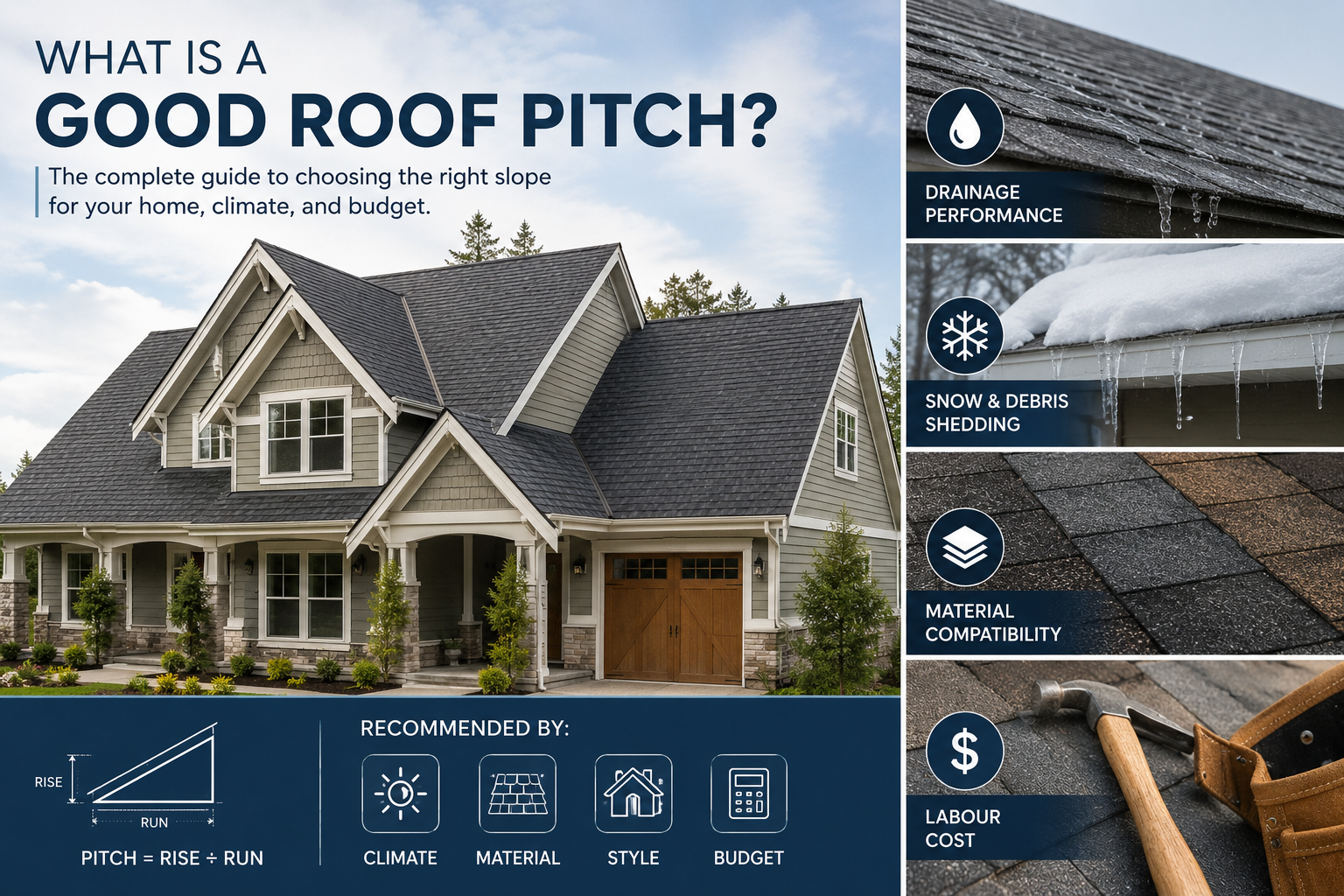
What Is a Good Roof Pitch? How to Choose the Right Slope for Your Home
There's no single "best" roof pitch — the right slope depends on your climate, architectural style, roofing material, and budget. But there are well-established ranges that work for specific situations, and choosing outside those ranges creates real problems: improper drainage, voided warranties, excess snow load, or premium labour costs you didn't plan for. This guide breaks down what makes a pitch "good" for each scenario so you can evaluate an existing roof or specify the right slope on a new build.
⚡ Identify Your Current Pitch in SecondsUse the free Pitch Gauge to measure your existing roof instantly, then cross-reference it against the pitch chart to see where it falls on the performance spectrum.
Measure My Pitch → Download iOS App →
The Short Answer: 4/12 to 9/12 Covers Most Residential Roofs
For a standard US residential home with asphalt shingles, a pitch between 4/12 and 9/12 is considered the normal working range. Within that band, 6/12 (26.57°) is the most popular single pitch in American construction for good reason — it hits a sweet spot on every important dimension.
Outside of this range, you're making trade-offs:
- Below 4/12: Asphalt shingles are no longer recommended without special installation; water drainage is marginal in heavy rain
- Above 9/12: Fall protection mandatory, labour costs significantly higher, material usage increases sharply
Performance Factors That Define a "Good" Pitch
1. Water drainage
Steeper roofs shed water faster and more reliably. A 4/12 pitch gives water adequate time to run off before pooling, assuming clean gutters and intact flashing. Below 3/12, water movement slows enough that minor imperfections in the waterproofing layer become significant leakage risks. In high-rainfall climates, 6/12 or steeper is the smart choice for asphalt shingles. Use the pitch reference chart to see how your pitch compares on drainage performance.
2. Snow load management
Snow doesn't automatically slide off a roof — it requires the right combination of pitch and roof surface temperature. For natural snow shedding in moderate snow climates, a minimum of 6/12 is generally recommended. In heavy snow regions (Midwest, New England, Rockies), 8/12 to 10/12 is common to ensure snow clears before ice dams form. Very steep pitches (12/12+) shed snow almost immediately but create significant snow drop hazards at the eave line. Low-slope roofs in snow country require structural design for the full calculated snow load rather than relying on shed.
3. Material compatibility
This is non-negotiable — your pitch must meet the minimum slope for your chosen material. Below minimums, manufacturer warranties are voided and the installation typically violates local building code:
| Material | Minimum pitch | Sweet spot |
|---|---|---|
| Asphalt shingles | 4/12 (2/12 with ice & water) | 6/12 – 8/12 |
| Metal standing seam | 1/12 | 3/12 – 6/12 |
| Metal shingles | 3/12 | 4/12 – 8/12 |
| Clay / concrete tile | 4/12 (2.5/12 some products) | 5/12 – 9/12 |
| Wood shakes | 4/12 | 6/12 – 9/12 |
| Slate | 6/12 | 8/12 – 12/12 |
| TPO / EPDM membrane | 0.25/12 | 0.5/12 – 2/12 |
4. Labour cost and safety
Every pitch increment above 6/12 adds cost. Contractors typically apply a steep-pitch surcharge starting at 7/12 — between 10–25% premium depending on the market — to cover additional setup time, fall protection equipment, slower working pace, and liability. At 10/12 and above, OSHA fall protection requirements apply to commercial work, and most residential contractors follow the same standards.
5. Attic ventilation and usable space
Steeper pitches create more attic volume, which can be finished as living space (dormers, bonus rooms) or simply provide better natural ventilation. Low-slope roofs often struggle with adequate ridge-to-soffit airflow, which leads to moisture buildup and reduced shingle life. A 6/12 pitch or steeper generally provides the minimum attic height to allow a crew to move around for insulation work and future re-roofing access.
Recommended Pitches by Climate
| Climate | Recommended range | Reasoning |
|---|---|---|
| Hot, dry (Southwest) | 3/12 – 6/12 | Low precipitation; flat modern aesthetics common |
| Mild, moderate rain (Pacific NW) | 6/12 – 9/12 | High rainfall volume requires reliable run-off |
| Heavy snow (Northeast, Midwest) | 6/12 – 12/12 | Natural snow shedding critical; 8/12+ preferred |
| High winds (Gulf Coast, Florida) | 4/12 – 6/12 | Lower profile reduces wind uplift on sheathing |
| Mixed seasons (Mid-Atlantic) | 5/12 – 8/12 | Balanced performance across all weather types |
What Pitch Is Right for Each Architectural Style?
Architecture and pitch are deeply connected. Changing a pitch dramatically outside the historically appropriate range for a style looks wrong — the proportions of the house change and resale value can be affected. Here are the typical pitch ranges for common American residential styles:
- Ranch / contemporary modern: 3/12 – 5/12. Low profile is intentional.
- Colonial / traditional: 6/12 – 9/12. Balanced, symmetrical gables.
- Cape Cod: 8/12 – 10/12. Steep to maximise upstairs living space under the roof.
- Victorian / Queen Anne: 10/12 – 14/12. Dramatic height is part of the aesthetic.
- Tudor / Gothic revival: 12/12 – 18/12 on gables. Very steep by design.
- Craftsman / bungalow: 5/12 – 8/12. Moderate pitch with prominent overhangs.
⚠️ Reroofing note: When replacing a roof, you're generally constrained to the existing pitch. Changing pitch on a reroof requires changing the rafter structure — a structural project, not a roofing project. However, adding a steeper-pitch overlay (like a fake mansard skirt at the eave) is occasionally done for aesthetic reasons. Always consult a structural engineer before modifying roof pitch on an existing building.
The 6/12 Pitch: Why It's the Default Choice
The 6/12 pitch (26.57°) dominates American residential construction for several practical reasons that reinforce each other:
- Universal material compatibility: Every standard roofing product is approved at 6/12 with standard installation procedures. No special low-slope applications, no exceptions, no warranty footnotes.
- Strong drainage without steep-slope surcharge: 6/12 sheds water reliably in all but extreme rainfall events, without triggering the labour premium contractors charge at 7/12+.
- Walkable for most workers: A crew can walk a 6/12 roof in dry conditions without additional equipment, which keeps installation times down.
- Attic ventilation: Creates enough ridge height for effective ridge-to-soffit airflow with standard vent products.
- Visual proportion: Works harmoniously with a wide range of home styles — from Craftsman to Colonial to contemporary.
If you're specifying a new roof and don't have a strong reason to go higher or lower, 6/12 is the answer. Measure it using the pitch gauge and verify it with the roof calculator to see how the material quantities work out for your specific building.
📐 See How Your Pitch Affects Material CostEnter your pitch and base area into the free Roof Calculator to see roof area, shingle bundles, and total project cost at your specific slope. Compare pitches side by side by running the calculator twice.
Open Roof Calculator → Download iOS App →
Frequently Asked Questions
What is the minimum roof pitch for asphalt shingles?
The minimum pitch for standard asphalt shingle installation with full manufacturer warranty is 4/12. Installation between 2/12 and 4/12 is technically possible but requires a low-slope application — typically a self-adhering ice-and-water shield over the entire roof deck, specific nail patterns, and closer inspection. Below 2/12, asphalt shingles should not be used regardless of underlayment. Check your specific product's installation manual as requirements vary by manufacturer.
What is the most common residential roof pitch?
The most common residential roof pitch in the United States is 6/12 (26.57°), followed closely by 4/12 and 5/12 in lower-profile homes. The 6/12 pitch has been the default choice for decades because it satisfies drainage, material, walkability, and aesthetic requirements simultaneously for most residential applications.
Is a steeper roof better?
Steeper roofs shed water and snow more efficiently, can use a wider range of premium materials (slate requires 6/12 minimum), and often look more dramatic architecturally. However, they cost more to build and maintain — more material, higher labour costs, and mandatory fall protection at 10/12 and above. Whether steeper is "better" depends on your climate, budget, and style. For most homeowners, 6/12 to 8/12 offers the best balance.
Can I change my roof pitch without a structural change?
No — increasing pitch on an existing roof requires modifying the rafter structure (adding raised collar ties, installing new rafters at a steeper angle, or reframing the entire roof). This is a structural project that requires a permit and engineer sign-off. You cannot simply apply steeper shingles over existing framing to get a different pitch. What you can do without structural work is change the roofing material on the same pitch, or add dormers that have their own independent pitch.
What pitch is best for a garage or shed?
For a simple attached or detached garage, a 4/12 to 6/12 pitch is appropriate for most climates. It keeps the garage profile proportional to the house, uses standard materials, and is straightforward to frame. In snow country, 6/12 minimum is recommended to ensure snow shedding away from doors and walkways. For a simple storage shed, even a 3/12 or 2/12 shed roof works well — low cost, easy to frame, and functional.
Does roof pitch affect home insurance rates?
In some regions and with some insurers, yes. Steeper roofs (7/12+) may receive slightly lower rates in areas prone to heavy rain or snow due to better drainage and natural snow shedding. However, very steep roofs can be penalised in high-wind areas where uplift risk increases. The impact varies significantly by insurer and location — ask your insurance provider directly how they rate roof pitch for your specific address.