Thread Pitch Gauge Guide: Types, How to Read, and Which to Buy
A single bolt can look right, fit loosely into a hole, and then strip the threads the moment you torque it down — all because the pitch was off by half a millimetre. Thread pitch is one of the most commonly overlooked fastener specifications, and it causes real damage when it's wrong: stripped holes, failed joints, snapped studs, and in safety-critical applications, catastrophic failures.
A thread pitch gauge eliminates that risk. It's a simple, inexpensive tool that tells you exactly what thread standard you're dealing with — before you order the wrong replacement, run the wrong tap, or cross-thread an expensive component. This guide covers every type of thread pitch gauge, how to use each one correctly, how to read the results, and what to look for when buying.
🏠 Looking for a roof pitch gauge instead?
If you landed here looking to measure roof steepness rather than screw threads, you want our free digital roof pitch gauge — it measures any roof slope instantly using your phone.
What Is a Thread Pitch Gauge?
A thread pitch gauge — also called a screw pitch gauge, thread gauge, or screw thread pitch gauge — is a precision hand tool used to identify the pitch of a threaded fastener. "Pitch" in this context means the distance between adjacent thread crests, either expressed in millimetres (for metric threads) or as threads per inch — TPI — (for imperial threads).
The tool works by physical template matching: each blade in the gauge set has teeth cut to a precise thread profile. You press blades against the fastener until you find the one that matches perfectly — no gaps, no rocking. The value stamped on that blade is your thread pitch.
Thread pitch defined:
Metric: Distance in mm between thread crests. A 1.5mm pitch means each thread is 1.5mm apart.
Imperial: Number of threads per inch (TPI). A 20 TPI thread has 20 complete threads in one inch of fastener length.
Thread pitch gauges are standard equipment in automotive workshops, machine shops, maintenance departments, fabrication facilities, and anywhere that fasteners need to be identified, sourced, or replicated. They are not related to roof pitch gauges — if you need to measure how steep a roof is, see the roof pitch gauge tool instead.
Why Thread Pitch Matters
Pitch is one of three properties that fully define a threaded fastener, alongside nominal diameter and thread form. Two fasteners can be identical in every visible way — same diameter, same length, same head style, same material — and still be incompatible if their pitch differs.
Consider an M10 bolt. Three pitch variants exist for that single diameter:
| Designation | Pitch | Thread type | Typical use |
|---|---|---|---|
| M10 x 1.5 | 1.5mm | Coarse (standard) | General purpose, structural |
| M10 x 1.25 | 1.25mm | Fine | Automotive, precision assemblies |
| M10 x 1.0 | 1.0mm | Extra fine | High-precision instruments |
Force an M10 x 1.5 bolt into an M10 x 1.25 hole and you will strip the thread — possibly permanently. In aluminium components, the damage is often irreparable without a helicoil insert. In steel structural connections, it creates a joint that appears tight but carries no load. Thread pitch gauges prevent this class of mistake entirely.
⚠️ Never assume: Never assume a fastener is metric because the equipment looks European, or imperial because the equipment looks American. Most modern machines and vehicles use a mix of both systems. Always gauge an unknown fastener before running it into a tapped hole — especially in aluminium, stainless, or any high-value component.
Types of Thread Pitch Gauge
1. Leaf-type thread pitch gauge
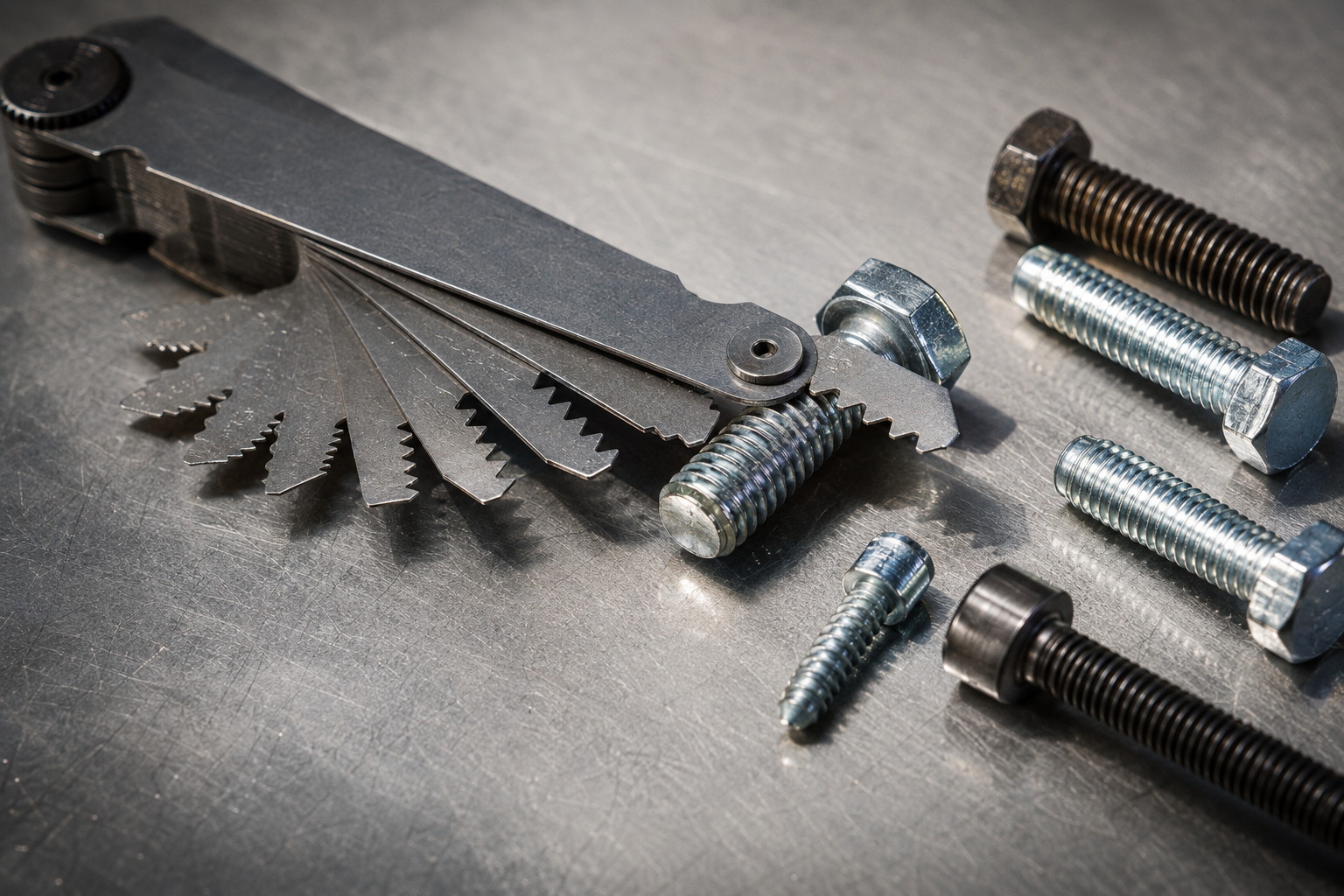
The leaf-type gauge is the most common and most practical thread pitch gauge for general workshop use. It consists of a set of thin hardened steel blades — typically 20 to 60 per set — fanned out from a central rivet, like a Swiss army knife. Each blade has a precise tooth profile ground into its edge that matches a specific thread standard. The blades are stamped with their pitch value.
How it works: Select a blade that looks approximately right, press it against the thread, and check the fit. Keep trying blades until you find the one that seats flush with zero gaps. That blade's value is your pitch.
Pros: Inexpensive ($5–$25 for a quality set), compact, no batteries, no calibration required, works on external and internal threads, lasts indefinitely with basic care.
Cons: Requires physical access to the thread, worn or damaged threads can make fit ambiguous, and some very fine pitches (below 0.5mm or above 60 TPI) may not be included in standard sets.
Best for: General automotive, maintenance, and fabrication work. The default choice for most workshops.
2. Double-sided combination gauge (metric + imperial)
A combination thread pitch gauge set includes blades calibrated for both metric (mm) and imperial (TPI) thread standards in a single tool — often with metric blades on one side and imperial blades on the other, separated by colour-coded markings. This is the most practical choice for workshops dealing with equipment from multiple countries of origin, which in practice means almost every professional automotive, agricultural, and industrial workshop today.
Typical coverage: Metric blades from 0.4mm to 3.5mm; imperial blades from 4 TPI to 80 TPI. A good combination set covers virtually every standard fastener pitch in common use.
Best for: Any workshop that handles both metric and imperial equipment. The most versatile single purchase in this category.
3. Dedicated metric thread pitch gauge
A metric-only gauge set contains a higher density of metric pitch values — sometimes including pitches like 0.35mm and 0.45mm that are omitted from combination sets to save blade count. For workshops working exclusively with metric fasteners or needing to identify very fine metric pitches in precision instruments, a dedicated metric set offers better resolution than a combination tool.
Best for: European machinery, CNC equipment, precision engineering, or any environment where metric is the exclusive standard.
4. Dedicated imperial / unified thread pitch gauge
An imperial-only gauge covers the Unified Thread Standard (UTS) used in the United States — including Unified Coarse (UNC) and Unified Fine (UNF) series. Pitch values are expressed in TPI. Common ranges cover 4 TPI through 80 TPI, with a dedicated set including finer increments than most combination tools provide.
Best for: US domestic manufacturing, aerospace (which uses many fine unified threads), and legacy industrial equipment built before metrication.
5. Thread and pitch gauge (profile gauge)
A thread profile gauge — sometimes called a thread form gauge — goes a step further than pitch-only identification. In addition to measuring pitch spacing, it verifies that the thread profile (the shape of the thread cross-section) matches a specific standard: 60° for metric and unified, 55° for BSW/BSP (British Standard Whitworth/Pipe), 29° for ACME threads, and so on. These are used primarily in precision machining, tooling verification, and quality control rather than general identification work.
Best for: Quality control, machining shops, toolmakers, and any application where thread form — not just pitch — needs to be verified.
6. Optical and digital thread gauges
High-end thread measurement uses optical comparators, digital thread micrometers, or vision-based measurement systems. These tools measure pitch, diameter, angle, and form with laboratory-grade accuracy — but cost hundreds to thousands of dollars and are used in production quality control and metrology labs rather than workshop identification. For most practical purposes, a leaf-type gauge is entirely sufficient.
Complete Thread Pitch Reference Tables
Common metric thread pitches (ISO standard)
| Diameter | Coarse pitch | Fine pitch | Extra fine pitch | Common applications |
|---|---|---|---|---|
| M3 | 0.5mm | 0.35mm | — | Electronics, small instruments |
| M4 | 0.7mm | 0.5mm | — | Light machinery, panels |
| M5 | 0.8mm | 0.5mm | — | General mechanical assemblies |
| M6 | 1.0mm | 0.75mm | — | General machinery, bike components |
| M8 | 1.25mm | 1.0mm | — | Engine components, general assemblies |
| M10 | 1.5mm | 1.25mm | 1.0mm | Automotive, structural connections |
| M12 | 1.75mm | 1.5mm | 1.25mm | Suspension, heavy machinery |
| M14 | 2.0mm | 1.5mm | — | Wheel bolts, structural |
| M16 | 2.0mm | 1.5mm | — | Structural bolts, large equipment |
| M20 | 2.5mm | 1.5mm | — | Heavy structural, agricultural |
| M24 | 3.0mm | 2.0mm | — | Civil engineering, cranes |
Common imperial thread pitches (Unified Thread Standard)
| Diameter | UNC (coarse) TPI | UNF (fine) TPI | Common applications |
|---|---|---|---|
| #6 (0.138") | 32 | 40 | Sheet metal, small assemblies |
| #8 (0.164") | 32 | 36 | Light general purpose |
| #10 (0.190") | 24 | 32 | Machine screws, electronics |
| 1/4" (0.250") | 20 | 28 | General purpose, most common size |
| 5/16" (0.3125") | 18 | 24 | General mechanical assemblies |
| 3/8" (0.375") | 16 | 24 | Structural, automotive |
| 1/2" (0.500") | 13 | 20 | Structural bolts, heavy machinery |
| 5/8" (0.625") | 11 | 18 | Heavy structural, agricultural |
| 3/4" (0.750") | 10 | 16 | Civil engineering, anchor bolts |
| 1" (1.000") | 8 | 12 | Large structural, mining |
How to Use a Thread Pitch Gauge: Step by Step
Step 1: Clean the fastener
Remove all dirt, grease, rust, paint, and debris from the thread. A contaminated thread prevents the gauge blade from seating correctly and will give you a false reading — or make it impossible to find a match at all. Use a wire brush, thread chaser, or compressed air for stubborn deposits. The thread must be clean enough that you can see individual crests clearly.
Step 2: Identify the thread system
Make a visual determination of whether the fastener is likely metric or imperial before you start gauging. Metric fasteners typically have markings on the head (property class numbers like 8.8, 10.9, or 12.9 for bolts; a number or dot pattern for nuts). Imperial fasteners use radial line markings (SAE grade marks). If the head is unmarked or corroded, measure the diameter with a calliper — metric bolts come in round millimetre diameters (6mm, 8mm, 10mm), while imperial bolts come in fractional inch sizes (1/4", 5/16", 3/8").
💡 Quick diameter check: An M10 bolt measures approximately 9.85mm across the thread crests. A 3/8" bolt measures approximately 9.5mm (0.375"). These are close enough to be confused by eye but distinct with callipers. When in doubt, gauge both metric and imperial — the correct blade will be obvious once you have a match.
Step 3: Select your starting blade
Make a rough visual estimate of the thread spacing. Coarse threads — widely spaced, prominent crests — will match the lower-pitch blades (1.5mm–3.0mm for metric, 8–16 TPI for imperial). Fine threads — closely packed, subtle — will match higher-pitch blades (0.5mm–1.0mm metric, 24–40 TPI imperial). Start your search in the middle of that range and work outward.
Step 4: Test the blade against the thread
Hold the gauge blade parallel to the fastener axis and press the toothed edge firmly against the thread crests. Try to engage at least 5–6 full thread pitches for a reliable reading. Rock the blade gently — a correct match has zero play. Look at the contact zone from the side at a shallow angle: even a 0.25mm pitch mismatch will show a visible gap between blade teeth and thread crests.
Step 5: Confirm the match
When you find a blade that appears to fit, confirm it by checking along the full engaged length and from multiple angles. The teeth should sit flush on every thread crest with no visible light gaps. If there is any ambiguity — particularly between adjacent pitches like 1.25mm and 1.5mm — try both blades back-to-back. The difference becomes clear when you compare them directly.
Step 6: Read and record the pitch
The matching blade is stamped with its pitch value. For metric: record the value in mm (e.g. 1.5mm). For imperial: record the TPI value (e.g. 20 TPI). Combined with the diameter measurement from your calliper, you now have the full thread designation — e.g. M10 x 1.5, or 3/8"-16 — needed to order a replacement fastener, specify a tap or die, or document the thread for a machining drawing.
⚠️ Worn threads: Heavily worn or damaged threads can make pitch identification ambiguous even with a correct blade. If the thread crests are visibly rounded, chipped, or corroded, measure pitch on the cleanest section available. If the thread is too damaged for a reliable gauge reading, a thread pitch micrometer or optical comparator may be needed for a definitive measurement.
How to Read Thread Pitch Gauge Results
Reading metric pitch values
Metric blade values are straightforward: the stamped number is the distance in millimetres between thread crests. A blade marked 1.5 means 1.5mm pitch. Combined with the nominal diameter, this gives the full ISO thread designation: M10 x 1.5 means a 10mm diameter bolt with 1.5mm pitch.
One common source of confusion: metric pitch and metric diameter both use millimetres but refer to completely different measurements. The diameter is the outer width of the bolt shank; the pitch is the thread spacing. They are independent of each other — an M10 bolt can have a 1.5mm, 1.25mm, or 1.0mm pitch depending on the series.
Reading imperial TPI values
Imperial blade values represent threads per inch. A blade marked 20 means 20 complete thread crests within one inch of fastener length. The full designation combines diameter and TPI: 1/4"-20 means a 1/4 inch diameter bolt with 20 TPI. Note that a higher TPI number means a finer thread — more threads packed into the same inch — which is the opposite intuition from metric, where a higher pitch number means coarser (more widely spaced) threads.
| System | Higher number = ? | Example: coarse | Example: fine |
|---|---|---|---|
| Metric (mm) | Coarser thread (wider spacing) | M10 x 1.5mm | M10 x 1.0mm |
| Imperial (TPI) | Finer thread (tighter spacing) | 1/2"-13 TPI | 1/2"-20 TPI |
Which Thread Pitch Gauge Should You Buy?
Your choice depends on the type of work you do and the range of fasteners you encounter:
| Your work | Recommended gauge type | Budget |
|---|---|---|
| General automotive / mechanical | Combination metric + imperial leaf set | $10–$25 |
| European machinery / CNC | Dedicated metric leaf set (full range) | $10–$20 |
| US industrial / aerospace | Dedicated imperial leaf set (UNC + UNF) | $10–$20 |
| Mixed international equipment | Double-sided combination set (wide range) | $15–$35 |
| Precision machining / quality control | Thread profile gauge + optical verification | $40–$200+ |
| Occasional DIY use | Budget combination leaf set | $5–$15 |
What to look for when buying
- Hardened steel blades — the blades must be hard enough that repeated contact with fastener threads does not round off the gauge teeth. Cheap sets with soft blades become inaccurate quickly.
- Clear stampings — blade values should be deeply and cleanly stamped, not printed or etched. Stampings must remain readable after years of workshop use.
- Smooth pivot action — blades should fan out and fold back without catching. A stiff pivot makes one-handed use awkward and increases the chance of selecting the wrong blade.
- Blade count vs. pitch coverage — more blades does not always mean more useful coverage. Verify that the specific pitches you actually need are included in the set before purchasing.
- Protective case or pouch — blades stored loose in a toolbox collect contaminants and get bent. A case or folding holder keeps the set usable for longer.
💡 Brand note: For workshop identification purposes, mid-range gauge sets from established tooling brands (Starrett, Mitutoyo, Fowler, or their equivalents) are accurate and durable. Budget combination sets from general tool suppliers are adequate for DIY and occasional use. For quality control or metrology applications, brand and traceable calibration both matter.
Thread Pitch Gauge vs Other Thread Measurement Tools
| Tool | Measures | Best for | Cost |
|---|---|---|---|
| Leaf pitch gauge | Pitch only | General identification | $5–$35 |
| Calliper | Diameter only | Diameter identification | $15–$80 |
| Thread pitch micrometer | Pitch with high precision | Machining, QC | $80–$400 |
| Go/no-go thread gauge | Thread fit / tolerance | Production QC | $20–$150 per size |
| Optical comparator | Pitch, form, diameter | Metrology lab | $500–$10,000+ |
For most practical identification tasks, a leaf-type thread pitch gauge combined with a digital calliper gives you everything you need to fully specify any standard fastener. The combination costs under $50 and handles 99% of real-world thread identification work.
🏠 Need a roof pitch gauge instead?
If you are working on a roofing project rather than a fastener identification task, the free Roof Pitch Gauge uses your phone's sensors to measure any roof slope instantly — no hardware needed.
Frequently Asked Questions
What is a thread pitch gauge used for?
A thread pitch gauge is used to identify the pitch — the spacing between thread crests — of a screw, bolt, nut, or threaded hole. This information is needed when ordering replacement fasteners, selecting the correct tap or die for machining, specifying thread callouts on engineering drawings, or verifying that an unknown fastener matches a required standard. Without a gauge, pitch can only be estimated visually, which frequently leads to ordering the wrong parts or cross-threading expensive components.
What is the difference between a thread gauge and a thread pitch gauge?
A thread gauge is a broad category covering any tool that verifies thread characteristics, including diameter, pitch, form, fit, and tolerance — go/no-go gauges, ring gauges, and plug gauges all fall under this umbrella. A thread pitch gauge specifically measures pitch only (the spacing between threads) and does not verify diameter or tolerance. For general workshop identification, the thread pitch gauge is the tool you need. For production quality control, full thread gauges that verify fit and tolerance are required.
How do I know if a thread is metric or imperial?
Check the bolt head markings first: metric bolts show property class numbers (8.8, 10.9, 12.9); imperial bolts show SAE radial line grades (no lines = Grade 2, three lines = Grade 5, six lines = Grade 8). If markings are unclear, measure the diameter with callipers — metric bolts come in whole millimetre sizes (6mm, 8mm, 10mm), while imperial bolts come in fractional inch sizes (1/4", 3/8", 1/2"). When in doubt, try both gauge sets — only one will give a clean flush fit.
Can I use a thread pitch gauge on internal threads (inside a nut or hole)?
Yes, but it is more difficult than gauging external threads. Fold the blade out to its fully extended position, insert it into the threaded hole at an angle, then align it with the thread axis and press it against the internal thread crests. The fit criteria are the same — flush contact with no gaps — but visualising the fit inside a hole requires good lighting and sometimes a pick or dental mirror to see the contact zone clearly. For most identification tasks, it is easier to gauge a matching external bolt if one is available.
What does thread pitch mean for a screw?
Thread pitch describes how tightly wound the threads are — the distance from one thread crest to the next. For metric screws it is expressed in millimetres: a pitch of 1.0mm means adjacent thread crests are 1.0mm apart. For imperial screws it is expressed as threads per inch (TPI): a pitch of 20 TPI means 20 complete threads fit within one inch of the screw's length. A higher metric pitch number means coarser (more widely spaced) threads; a higher TPI number means finer (more tightly packed) threads.
Do I need a separate pitch gauge for metric and imperial threads?
Not necessarily — combination leaf-type gauge sets include blades for both metric and imperial thread standards in a single tool, typically marked and colour-coded to distinguish the two systems. A combination set is the practical choice for most workshops. Dedicated single-system sets are only preferable if you need a wider range of values within one system than a combination set provides, or if you are doing precision work where the dedicated set offers finer pitch increments than a combination tool covers.