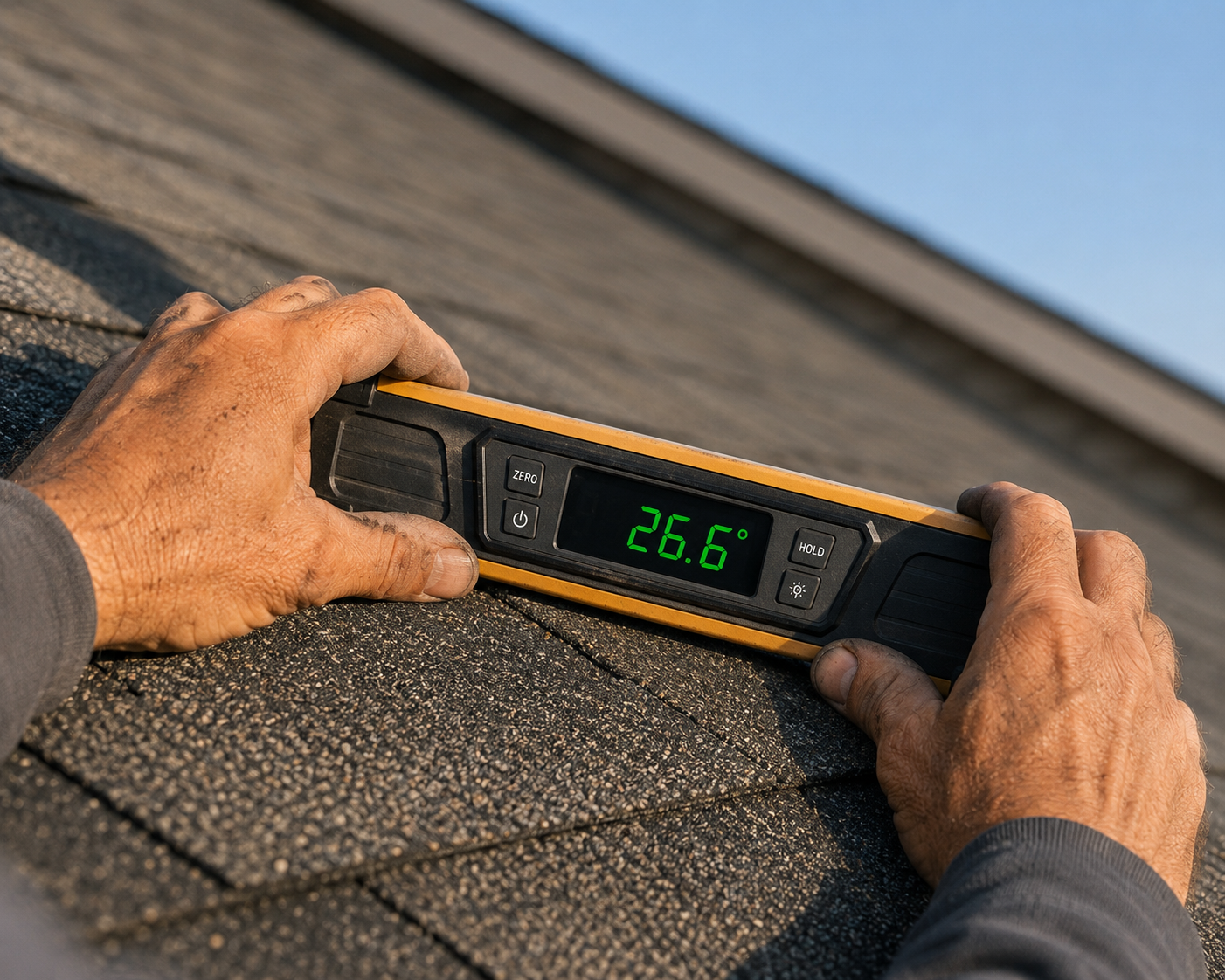
Roof Pitch to Degrees: Complete Conversion Chart and Formula
Roof pitch and degrees measure the same thing — the steepness of a roof — but they're two different languages, and knowing both is essential on the job. American contractors speak in x/12 ratios (6/12, 8/12), while architects often work in degrees, metric countries use percentages, and smartphone inclinometers return angles. This guide gives you the complete conversion chart, the exact formula, and a plain-English explanation of when each format matters.
⚡ Convert Any Pitch InstantlyThe Pitch Converter handles every format — x/12 to degrees, degrees to x/12, percentage slope, and metric. Enter one value and all the others appear instantly.
Open Converter → Download iOS App →
Complete Roof Pitch to Degrees Conversion Chart
This table covers every standard residential pitch from 1/12 to 12/12, plus the intermediate half-pitches that appear frequently in the field. The percentage column is used in commercial roofing specs and European projects. For a full breakdown with pitch factors and material recommendations, see the complete roof pitch reference chart.
| Pitch (x/12) | Degrees | % Slope | Decimal |
|---|---|---|---|
| 1/12 | 4.76° | 8.3% | 0.083 |
| 1.5/12 | 7.13° | 12.5% | 0.125 |
| 2/12 | 9.46° | 16.7% | 0.167 |
| 3/12 | 14.04° | 25.0% | 0.250 |
| 4/12 | 18.43° | 33.3% | 0.333 |
| 5/12 | 22.62° | 41.7% | 0.417 |
| 6/12 ★ | 26.57° | 50.0% | 0.500 |
| 7/12 | 30.26° | 58.3% | 0.583 |
| 8/12 | 33.69° | 66.7% | 0.667 |
| 9/12 | 36.87° | 75.0% | 0.750 |
| 10/12 | 39.81° | 83.3% | 0.833 |
| 11/12 | 42.51° | 91.7% | 0.917 |
| 12/12 | 45.00° | 100.0% | 1.000 |
★ Most common US residential pitch.
The Formula: How to Convert Pitch to Degrees
The conversion uses the arctangent trigonometric function:
Degrees = arctan(rise ÷ run) = arctan(rise ÷ 12)
Example: Convert 8/12 pitch to degrees
- Rise = 8, Run = 12
- Divide: 8 ÷ 12 = 0.6667
- Take the arctangent: arctan(0.6667) = 33.69°
On a scientific calculator, the arctan button is usually labelled "tan⁻¹" or "atan." On a phone calculator, switch to scientific mode and press the same key after entering your decimal.
The Formula: How to Convert Degrees Back to Pitch
Rise = tan(degrees) × 12
Example: Convert 30° to x/12 pitch
- tan(30°) = 0.5774
- Multiply by 12: 0.5774 × 12 = 6.93
- Round to nearest standard pitch: 7/12 (30.26°)
This is the calculation your phone's inclinometer is doing in the background when you use the pitch gauge. When it reads 26.57° it's reporting a 6/12 pitch. When it reads 33.69° that's 8/12.
Converting to Percentage Slope
Percentage slope is common in commercial roofing specifications, civil engineering, and European building standards. The calculation is straightforward:
% Slope = (rise ÷ run) × 100 = (rise ÷ 12) × 100
A 6/12 pitch = (6 ÷ 12) × 100 = 50% slope. A 3/12 pitch = 25% slope. The unit converter handles all three formats — x/12, degrees, and percentage — simultaneously.
Why Your Smartphone Gives Degrees, Not Pitch
Phones use built-in accelerometers and gyroscopes that measure physical angles — the angle the device makes with the horizontal plane — and that measurement is naturally in degrees. It's the same physics your inclinometer, digital level, or transit uses.
When you hold your phone against a 6/12 roof and the screen shows 26.57°, the phone is telling you the true angle of inclination. The pitch gauge converts that reading to the x/12 format contractors use, displays both simultaneously, and lets you save the result with a timestamp — no mental arithmetic required on the job site.
✅ Quick mental conversion tip: A 6/12 pitch is almost exactly 26.5°. For every 2/12 increase in pitch, the angle goes up roughly 4°. So 8/12 ≈ 33.7°, 10/12 ≈ 39.8°. This isn't exact, but it's close enough to sanity-check a reading on the fly.
When Do You Need Degrees vs. Pitch Ratio?
| Situation | Format to use |
|---|---|
| Ordering shingles, underlayment, or material | x/12 ratio |
| Setting a circular saw bevel for rafter cuts | Degrees |
| Calculating roof area with pitch factor | x/12 ratio (for the pitch factor table) |
| Reading a phone inclinometer or digital level | Degrees (then convert) |
| Commercial roofing spec sheets | Degrees or % slope |
| Framing square layout | x/12 ratio |
| Solar panel installation angle | Degrees |
| European or metric projects | Degrees or % slope |
🔢 One Tool for Every FormatThe Pitch Converter converts between x/12, degrees, percentage slope, and metric equivalents. Enter your pitch from the pitch gauge, then plug it straight into the roof calculator for your material estimate.
Open Converter → Download iOS App →
Frequently Asked Questions
What is a 6/12 pitch in degrees?
A 6/12 roof pitch equals 26.57 degrees. It's the most common residential roof pitch in the United States. The calculation: arctan(6 ÷ 12) = arctan(0.5) = 26.57°. It represents a roof that rises 6 inches for every 12 inches of horizontal run.
What is a 4/12 pitch in degrees?
A 4/12 pitch equals 18.43 degrees. This is a gentle, low-profile slope common in ranch-style homes and many tract houses. The calculation: arctan(4 ÷ 12) = arctan(0.333) = 18.43°.
What is a 7/12 pitch in degrees?
A 7/12 pitch equals 30.26 degrees. This is the boundary pitch for walkability — most contractors consider 7/12 to require extra caution and begin applying steep-slope pricing. It's common in Colonial and Cape Cod style homes. Calculation: arctan(7 ÷ 12) = 30.26°.
How do I convert 30 degrees to roof pitch?
Use the formula: Rise = tan(30°) × 12 = 0.5774 × 12 = 6.93. Round to the nearest standard pitch: 7/12 (30.26°). A 30° reading on your inclinometer means the roof is very close to a 7/12 pitch. Use the converter for any non-standard angle.
What is the difference between roof pitch and roof slope?
In everyday roofing usage, pitch and slope are used interchangeably. Technically, "pitch" is the ratio of rise to the full span (total width of the building), while "slope" is rise over run (12 inches). On a symmetrical gable roof, the pitch in the strict sense is half the slope value. In practice, when a contractor says "6/12 pitch" they mean 6 inches of rise per 12 inches of run — what is technically the slope. Don't worry about the distinction on the job site; everyone uses "pitch" to mean the x/12 slope ratio.
How do I find the angle of a roof from a photo?
If you have a photo taken straight-on (from directly in front of the gable end), you can use a protractor app to measure the angle of the roof edge in the photo. The accuracy depends on the photo being taken from level and perpendicular to the gable. For a reliable measurement, the pitch gauge on a smartphone held against the actual roof surface will always be more accurate than estimating from a photo.