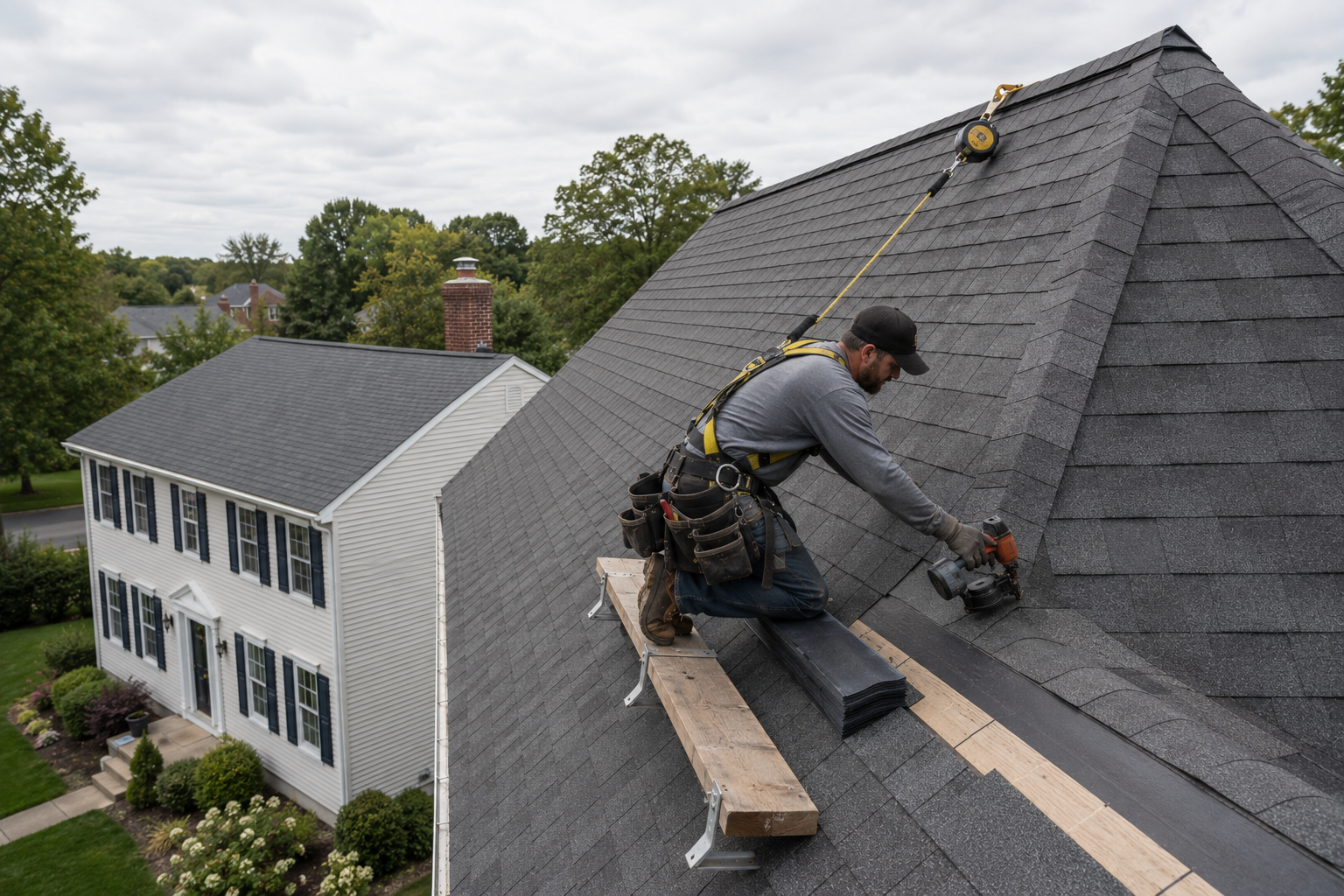
Roof Pitch Safety: Working on Steep Roofs (OSHA Guidelines)
Falls from roofs are the leading cause of fatalities in the construction industry. Every year, hundreds of workers are killed and thousands more are seriously injured in roofing falls — the majority on residential properties, on pitches that most people would consider "walkable." The dangerous assumption is not that steep roofs are dangerous (everyone understands that) — it's that a 6/12 or 7/12 roof is safe to walk without fall protection because it doesn't feel particularly steep underfoot.
OSHA data consistently shows that most fatal roofing falls happen on moderate-pitch roofs, not extreme ones, because that's where people take risks they wouldn't take on a visibly steep surface. Understanding exactly where the legal and practical safety thresholds are — and why they are where they are — is essential for every contractor, installer, and homeowner who sets foot on a roof.
📐 Know your roof pitch before you go up there
The free Pitch Gauge tool measures any roof slope from the attic in seconds — so you know exactly what safety equipment is required before anyone sets foot on the surface.
The OSHA Standard: What the Regulation Actually Says
The primary federal standard governing fall protection in residential roofing is OSHA 29 CFR 1926.502 — the construction industry fall protection standard — read alongside 29 CFR 1926.501(b)(13), which specifies residential construction fall protection requirements.
The key pitch threshold in OSHA's residential construction standard is 4/12 (18.43°). For any work on a residential roof with a pitch of 4/12 or greater, OSHA requires that employees be protected from falls by one of three systems:
- Personal fall arrest system (PFAS) — a harness connected to an anchor point via a lanyard or self-retracting lifeline, designed to arrest a fall before the worker hits the lower level
- Guardrail system — a barrier along the roof edge at a height of at least 42 inches, with mid-rail and toeboard components
- Safety net system — a net installed below the work area to catch falling workers
In residential construction, personal fall arrest systems are by far the most common approach since guardrails and nets are impractical on most residential roofs.
💡 The 4/12 threshold applies to all residential roofing work above 6 feet. OSHA's general industry fall protection threshold is any working surface where a fall of more than 4 feet is possible. For construction, the trigger is 6 feet. A worker on a 4/12 or steeper roof who is more than 6 feet above the lower level — which includes virtually any work on a full-size residential roof — is legally required to have fall protection in place.
The alternate procedure exception
OSHA 29 CFR 1926.501(b)(13) includes a limited exception — sometimes called the "alternate procedure" — that allows employers to use a written fall protection plan in lieu of the standard systems under specific conditions. This exception is narrow: it applies only when the employer can demonstrate that conventional fall protection is infeasible or creates a greater hazard, and the written plan must be developed by a qualified person and kept at the job site. It is not a general exemption from fall protection — it is a documented alternative when standard systems genuinely cannot be used.
This exception is frequently misunderstood or misapplied on residential job sites. The absence of a harness anchor point is not a valid reason for invoking the alternate procedure — it is a reason to install an anchor point before work begins.
Pitch-by-Pitch Safety Requirements
OSHA sets the legal minimum. Industry best practice — developed by organisations including NRCA (National Roofing Contractors Association), NIOSH, and major roofing manufacturers — extends those minimums into practical guidance for every pitch range. The table below summarises both the legal requirement and the industry-standard safety approach at each pitch level.
Don't know your exact pitch? Measure it from the attic with the Pitch Gauge tool before any roof access — the reading takes seconds and gives you X/12, degrees, and gradient simultaneously so you can cross-reference against both US and international safety standards. For a full degree and gradient breakdown of every pitch, see the roof pitch reference chart.
| Pitch | Degrees | OSHA requirement | Industry best practice | Walkability |
|---|---|---|---|---|
| 1/12 – 3/12 | 4.8° – 14.0° | Fall protection required if >6 ft above lower level | Edge protection and warning lines; PFAS recommended | Easy underfoot — edge hazard still significant |
| 4/12 – 6/12 | 18.4° – 26.6° | PFAS, guardrail, or safety net required | Full PFAS with properly anchored lifeline; roof jacks for extended work | Walkable with care — traction dependent on surface and footwear |
| 7/12 – 8/12 | 30.3° – 33.7° | PFAS required | PFAS required; roof jacks strongly recommended for all work positions | Uncomfortable unaided — roof jacks advisable |
| 9/12 – 10/12 | 36.9° – 39.8° | PFAS required | PFAS plus scaffolding or staging; roof jacks required | Very steep — cannot be safely walked without support |
| 11/12 – 12/12+ | 42.5° – 45°+ | PFAS required | Full scaffolding and fall arrest system; treat as high-angle access | Not walkable — full rigging required for any access |
⚠️ Low pitch is not the same as safe. The leading cause of fatal residential roofing falls is not extreme steep-slope work — it's workers on moderate 4/12 to 7/12 roofs who don't use fall protection because the surface "feels" walkable. A slip on a 5/12 roof at eave height is fatal from the same height as a slip on a 12/12 roof. The pitch affects how likely you are to slip; it does not change the consequences of the fall.
Personal Fall Arrest Systems: Components and Requirements
A personal fall arrest system (PFAS) consists of three components that must all meet OSHA specifications:
1. The anchor point
The anchor is the point where the system connects to the roof structure. OSHA requires that anchor points used in personal fall arrest systems be capable of supporting a minimum of 5,000 pounds per worker attached, or be designed and installed by a qualified person as part of a complete fall protection system with a safety factor of at least 2.
For residential roofing, the most common anchor types are:
- Roof peak anchors — temporary anchors that straddle the ridge and are secured by the weight of the bracket plus through-fastened straps. Rated for temporary use on roofs up to the manufacturer's maximum pitch.
- Through-bolted anchors — permanent or semi-permanent anchors fastened directly through the sheathing into a rafter or structural member. More secure than peak anchors; required for steep pitches and extended work periods.
- Beam anchors and parapet clamps — used on low-slope and flat roofs where through-fastening into the structure is the primary option.
Nailing a rope around a chimney, tying off to a plumbing vent, or securing to a skylight frame are not OSHA-compliant anchor points. The anchor must be rated for the load, inspected before each use, and removed or decommissioned when the load rating can no longer be verified.
2. The body harness
OSHA requires a full-body harness for personal fall arrest — not a body belt. Body belts were once common in roofing but are prohibited for fall arrest because they concentrate arrest forces on the abdomen, potentially causing internal injury. A full-body harness distributes arrest forces across the chest, shoulders, and thighs.
The harness must:
- Be inspected before each use for damage, worn webbing, corroded hardware, and compromised stitching
- Be fitted to the individual wearer — not adjusted for one person and worn by another without re-fitting
- Be stored away from UV exposure, chemicals, and heat when not in use
- Be retired immediately after any fall arrest event — even if no visible damage is present, the arrest forces may have compromised the webbing
3. The connecting element (lanyard or SRL)
The connecting element links the harness to the anchor. Two types are used in roofing:
- Shock-absorbing lanyard — a fixed-length lanyard (typically 6 feet) with a deceleration device that deploys on fall arrest to reduce peak arrest force. The total fall clearance (free fall distance plus deceleration distance plus harness stretch) must be available below the worker before the lanyard is appropriate. On low roof work positions, this clearance may not exist — meaning a 6-foot lanyard worker positioned 4 feet above the eave edge can still reach the ground during a fall arrest event.
- Self-retracting lifeline (SRL) — a spring-loaded retractable device that automatically takes up slack as the worker moves. Falls are arrested within inches rather than feet, making SRLs more appropriate than fixed lanyards for low-clearance roof work and for workers who need to move freely across a large roof area.
💡 Fall clearance calculation: Before positioning a worker with a shock-absorbing lanyard, calculate the total fall clearance required:
Total clearance = Free fall distance (max 6 ft) + Deceleration distance (max 3.5 ft) + Harness elongation (~1 ft) + Safety margin (3 ft) = ~13.5 ft minimum below anchor point
If 13.5 feet of clearance below the anchor does not exist — which is common on single-storey residential work — use an SRL instead of a lanyard.
Roof Jacks: What They Are and When They're Required
Roof jacks — also called roof brackets — are L-shaped metal brackets that are nailed through the sheathing into a rafter and hold a plank (typically a 2x10) to create a working platform on the roof surface. They are not a substitute for a personal fall arrest system — they are a work-positioning device that keeps the worker in a stable position while working, reducing the risk of a slip initiating in the first place.
The distinction matters: roof jacks prevent falls by keeping the worker stable. A PFAS arrests a fall that has already begun. Both are part of a complete steep-slope safety system — not alternatives to each other.
Roof jack requirements
- Roof jacks must be nailed into rafters — not into sheathing alone. A 16d nail through sheathing with no structural backing will pull through under load.
- The plank used on roof jacks must be sound, free from splits and large knots, and rated for the span between jacks. Never use engineered lumber (LVL, I-joist) as a roof jack plank.
- Roof jacks should be positioned so the working plank height puts the worker's centre of gravity below the knee, not at hip height or above.
- When removing roof jacks, tap the bracket upward to release the nail — do not pry outward, which can split the sheathing and leave a larger hole to seal.
- The nail holes left by roof jacks must be sealed before new roofing goes on. A common mistake is leaving unsealed jack nail holes under the first few courses of shingles, creating fastener-line leak points.
Ladder Safety for Roofing Work
A significant proportion of roofing falls happen not on the roof surface but on the ladder — during access and egress. Ladder safety is an integral part of roof pitch safety, not a separate topic.
OSHA ladder requirements for roofing
- Extension angle: The ladder must be positioned at a 4:1 angle — for every 4 feet of vertical rise, the base should be 1 foot away from the wall. This is the angle at which ladder rung-loading is optimised for safety and climbing efficiency.
- Eave clearance: The ladder must extend at least 3 feet above the eave to provide a stable handhold when transitioning onto and off the roof. A ladder that terminates at the eave line provides no support at the most dangerous transition point.
- Securing the ladder: Ladders must be tied, blocked, or otherwise secured against lateral movement at the top. An unsecured ladder that shifts sideways while a worker is transitioning to or from the roof causes the same type of fall as a ladder that slides at the base.
- Rated load: Use a ladder rated for at least the combined weight of the worker, tools, and any materials carried. For roofing work, a Type IA (300 lb rated) or Type I (250 lb rated) ladder is appropriate for most workers plus tool load. Type II (225 lb) is marginal; Type III (200 lb) is not appropriate for roofing work.
Setting up near work areas
The ladder must be positioned so that the worker reaches the roof surface at a point where standing is stable — not at the steepest section of the roof, not directly over a valley, and not in a position that requires a lateral step off the ladder onto an unstable surface. For steep-pitch roofs, position the ladder so the worker lands on the roof directly above a rafter line for maximum surface stability at the transition point.
Surface Conditions and Traction
Pitch is only one factor in roof walkability — surface condition often has more practical influence on slip risk than the angle itself.
| Surface condition | Risk level | Practical guidance |
|---|---|---|
| Dry asphalt shingles | Moderate — granule surface provides grip | Good traction up to 6/12 with appropriate footwear; use PFAS above 4/12 |
| Wet shingles | High — granules become lubricated | Do not work on wet shingle surfaces regardless of pitch |
| Metal panels (dry) | Moderate to high — smooth surface | PFAS required from 4/12; roof jacks from 5/12 for extended work |
| Metal panels (wet or morning dew) | Extreme | Do not access — even at very low pitches, wet metal is extremely slippery |
| Clay or concrete tiles | High — rounded profile and hard surface | Step only on the butt (lower) end of tiles, never the crown; PFAS required from 4/12 |
| Algae or moss growth | Extreme — biological growth dramatically reduces friction | Treat surface before access; PFAS mandatory at any pitch; do not work alone |
| Slate | High — smooth, hard, brittle if stepped on | Step only between slates on the battens; use crawling boards; PFAS required |
| OSB or bare sheathing | High — no surface texture, particularly when dusty | Treat as high-risk surface; roof jacks and PFAS from 3/12 |
Footwear
Appropriate footwear is one of the most cost-effective safety investments for roofing work. Soft-soled rubber shoes or boots with a flat sole and high grip compound significantly outperform standard work boots on roof surfaces. Purpose-made roofing boots with flexible rubber soles cut to a specific tread pattern for granule surfaces are available from major work boot manufacturers and are worth the investment for anyone doing regular roofing work.
Footwear with hard soles, worn soles, mud or debris clogging the tread, or oil contamination provides dramatically reduced traction on any roofing surface. Check soles before every roof access.
Specific Hazards at Different Pitch Ranges
Low and flat roofs (below 4/12): edge hazard
The primary hazard on flat and low-slope roofs is not the surface — it's the unguarded edge. A worker moving around on a flat roof can approach the edge without realising how close they are, particularly when carrying materials or looking down at work. Warning lines set back at least 6 feet from the unguarded edge, combined with a safety monitor or PFAS for anyone working between the warning line and the edge, are the standard OSHA-compliant approaches for low-slope work.
Conventional slopes (4/12 to 6/12): the most dangerous range
This is statistically the most dangerous range for roofing fatalities — not because it's the most technically challenging, but because it's the range where workers most commonly forgo fall protection due to perceived safety. The surface feels walkable. The risk feels manageable. The consequence of that misjudgement is the same as on any other roof height. Fall protection is legally required and professionally expected at all pitches in this range.
Steep slopes (7/12 and above): technical complexity
At 7/12 and above, the technical complexity of the work increases — roof jacks must be set, PFAS must be pre-positioned, scaffold may need to be erected before work begins, and material delivery to the work area requires more planning. These pitches also place more strain on the body, increasing fatigue, which in turn increases slip risk toward the end of a working day. Plan steep-pitch work for the cooler part of the day and build in more frequent breaks than on moderate-pitch work.
Homeowner Safety: When to Stay Off the Roof
Most of this guide has addressed contractor and professional practices. For homeowners, the guidance is simpler: for any roof above 3/12, treat access as a professional task unless you have the correct equipment, training, and a co-worker present for emergency response.
Specific situations where homeowners should never access their own roof without professional assistance:
- Any pitch above 6/12, under any conditions
- Any pitch when the surface is wet, icy, or covered with morning dew
- Any pitch when working alone with no one able to call emergency services
- Any pitch when the ladder setup is compromised — unlevel ground, inadequate extension above the eave, or no anchor point
- Any roof with tile, slate, metal, or algae/moss growth, regardless of pitch
- Any inspection or gutter work that requires leaning past the knee over a roof edge
For inspection, measurement, or estimating purposes, the Pitch Gauge tool reads any roof slope from inside the attic — no roof access required. And the roof calculator produces a complete material and cost estimate from that measurement without you ever needing to go on the roof surface at all.
A Pre-Work Roof Safety Checklist
Before accessing any roof above 4/12:
☑ Measure and confirm the exact pitch — use the Pitch Gauge from the attic
☑ Identify and inspect the anchor point — confirm load rating and structural connection
☑ Inspect the PFAS — harness, lanyard or SRL, connectors — for damage before each use
☑ Calculate fall clearance — confirm SRL is appropriate if clearance is less than 13.5 ft
☑ Check surface condition — wet, icy, or biologically contaminated surfaces are no-go
☑ Check footwear — clean soles, appropriate grip, no hard soles
☑ Set up the ladder correctly — 4:1 angle, 3 ft above eave, secured at top
☑ Confirm another person is present or aware — never work alone on a steep roof
☑ Assess weather — wind above 25 mph significantly increases fall risk; do not start steep work in deteriorating conditions
☑ Have a rescue plan — know how a fallen-but-arrested worker will be retrieved before the work starts
📐 Measure pitch safely from the attic — before anyone goes on the roof
The free Pitch Gauge reads any slope in seconds using your phone. Know your pitch, know your safety requirements, and get a full material estimate — all before setting foot on the surface.
Frequently Asked Questions
At what roof pitch does OSHA require fall protection?
OSHA requires fall protection for all residential roofing work at pitches of 4/12 (18.43°) or greater, when workers are more than 6 feet above the lower level — which includes virtually all work on a full-size residential roof. The required protection can be a personal fall arrest system (PFAS), guardrail system, or safety net system. For most residential roofing, a full-body harness connected to a rated anchor point via a shock-absorbing lanyard or self-retracting lifeline is the standard approach. Fall protection is also required on lower-slope roofs above 6 feet under the general construction fall protection standard (29 CFR 1926.501).
What is the safest pitch to walk on a roof?
Pitches below 4/12 (18.4°) are physically the easiest to walk on, but the safest pitch to work on is any pitch where you have appropriate fall protection in place — regardless of the number. A 3/12 roof without fall protection is not safe; a 7/12 roof with a properly anchored PFAS and roof jacks is. That said, from a purely physical stability standpoint, pitches up to 6/12 (26.6°) are generally walkable for experienced roofers in appropriate footwear under dry conditions. Above 7/12, roof jacks become advisable regardless of PFAS status.
Do homeowners need fall protection to work on their own roof?
OSHA's residential construction fall protection standard applies to employees — it does not legally mandate that homeowners use fall protection on their own property. However, the physics of a fall do not change based on whether you are a contractor or a homeowner. Homeowners who access their own roofs above 4/12 without fall protection face the same injury risk as contractors who violate OSHA standards. The practical recommendation is the same: use PFAS above 4/12, don't access above 6/12 without it, and consider any pitch above 7/12 as a job for a professional with proper equipment.
What is a personal fall arrest system for roofing?
A personal fall arrest system (PFAS) consists of three components: an anchor point rated for at least 5,000 lbs (attached to a structural member in the roof), a full-body harness that distributes arrest forces across the chest, shoulders, and thighs, and a connecting element — either a shock-absorbing lanyard or a self-retracting lifeline (SRL) — that links the harness to the anchor. The system is designed to arrest a fall before the worker reaches the lower level, with a maximum arrest force of 1,800 lbs on the worker's body. All three components must be inspected before each use and replaced after any fall arrest event.
Are roof jacks a substitute for a fall arrest harness?
No — roof jacks and a personal fall arrest system serve different functions and are not substitutes for each other. Roof jacks are work-positioning devices that provide a stable working platform and help prevent a slip from occurring. A PFAS arrests a fall that has already begun. On steep roofs, both systems are used together: the PFAS ensures that if a slip occurs (including a slip off the roof jack plank), the worker is arrested before reaching the lower level. Using roof jacks without a PFAS above 4/12 does not meet OSHA's fall protection requirement.
How do I measure my roof pitch safely without going on the roof?
The safest measurement method is to use the Pitch Gauge tool from inside the attic — hold your phone against an exposed rafter and read the pitch in seconds, with no roof access, no ladder, and no fall risk. If attic access isn't available, the gable-end geometry method measures building width and ridge height from the ground and calculates pitch without any climbing. Both methods are described in detail in our guide to measuring roof pitch without going on the roof.