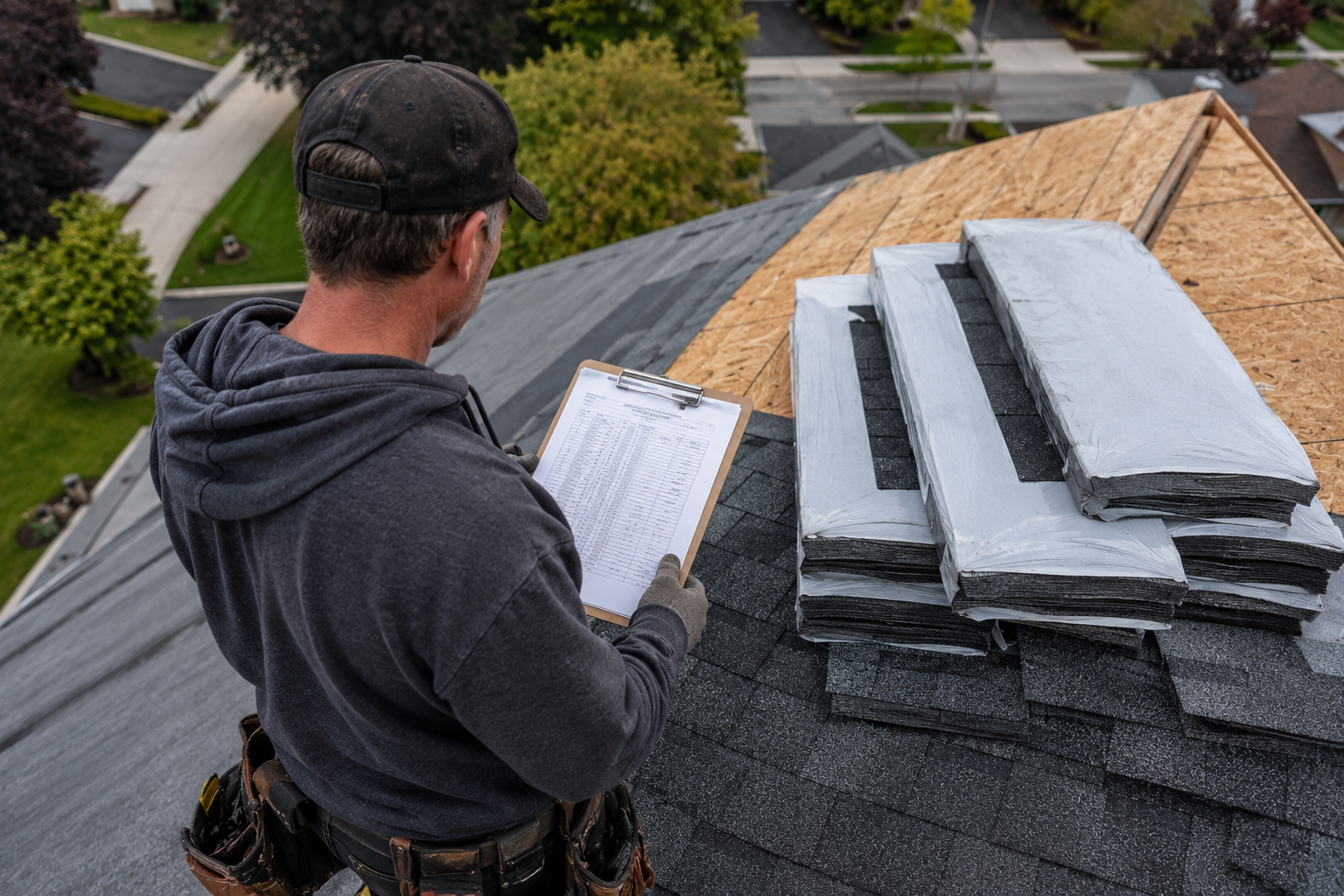
How Many Squares of Shingles Do I Need?
Ordering shingles is one of those tasks where being wrong in either direction costs you money. Order too few and you're paying for a second delivery, waiting on stock, and hoping the next batch matches your current dye lot. Order too many and you're storing material that depreciates, returning bundles you can't return, or leaving money on the job site. Getting the number right the first time is not complicated — it just requires understanding three things: how roofing squares work, how pitch affects your actual roof area, and how much waste to account for.
This guide walks through the complete calculation from building dimensions to bundles ordered, with a worked example for every common roof type. If you want to skip straight to the number, enter your dimensions and pitch into the free calculator below and it will do everything for you.
🔢 Calculate your shingle quantity right now — free
Enter your roof dimensions, pitch, and waste factor. The calculator outputs exact squares needed, bundle count, and a cost estimate — in seconds.
🔢 Open the Roof Calculator | 📐 Measure Your Roof Pitch First
What Is a Roofing Square?
A roofing square is a unit of area equal to 100 square feet. It is the standard unit used by roofing contractors, suppliers, and manufacturers for ordering and pricing shingles and other roofing materials. When a contractor quotes a job at "$350 per square installed," they mean $350 per 100 square feet of finished roof surface.
All shingle quantities, underlayment rolls, and roofing material orders are based on squares — not raw square footage — so understanding this unit is the foundation of any accurate estimate.
The core formula:
Roofing Squares = True Roof Surface Area ÷ 100
Where true roof surface area = Plan footprint area x Pitch multiplier
How Many Bundles of Shingles Per Square?
Most standard three-tab and architectural asphalt shingles are packaged so that 3 bundles = 1 square (100 sq ft). This is the most common packaging format and the one you should assume unless the manufacturer's documentation says otherwise.
Some heavier or larger-format shingles — certain premium architectural products, heavyweight laminated shingles, and some synthetic slate products — are packaged at 4 bundles per square. Always confirm the bundle coverage on the product label or data sheet before placing your order.
| Shingle type | Bundles per square | Sq ft per bundle |
|---|---|---|
| Standard 3-tab asphalt | 3 | 33.3 |
| Architectural / laminated | 3 | 33.3 |
| Premium heavyweight architectural | 4 | 25.0 |
| Designer / luxury shingles | 4 – 5 | 20.0 – 25.0 |
| Wood shingles | 4 | 25.0 |
| Wood shakes | 4 – 5 | 20.0 – 25.0 |
Step 1 — Measure Your Plan Area (Footprint)
The plan area is the horizontal footprint of your roof — the same as the floor area of the building below, measured to the outer edge of the roof overhang (not the wall face). This is the number you start with before applying the pitch multiplier.
Simple rectangular roof
Measure length x width to the outer edge of the fascia on all sides. If your roof overhangs the walls by 12 inches on each side, add 2 feet to both the length and width before multiplying.
Example: House footprint 42 ft x 28 ft, with 12-inch overhangs on all sides.
Plan area = (42 + 2) x (28 + 2) = 44 x 30 = 1,320 sq ft
L-shaped or complex plan
Divide the footprint into rectangles. Calculate each rectangle separately and add them together. For irregularly shaped buildings, sketch the plan view and break it into the simplest possible rectangles before measuring.
💡 Don't forget the overhangs. This is the single most common measurement mistake. The roof extends beyond the wall on all sides — typically 12 to 24 inches. Measuring to the wall face instead of the fascia edge understates your plan area by 5–10% on a typical house. Always measure to the outer edge of the fascia board or soffit.
Step 2 — Identify Your Pitch and Apply the Multiplier
A sloped roof covers more surface area than its flat footprint. The pitch multiplier converts your plan area into actual sloped surface area. You cannot accurately estimate shingles without it.
If you don't know your pitch, measure it now using the Pitch Gauge tool — hold your phone against a rafter in the attic and read the result in seconds. Then find your multiplier in the table below or use the full reference in the pitch reference chart.
| Pitch | Degrees | Multiplier | Area increase over flat |
|---|---|---|---|
| 3/12 | 14.0° | 1.031 | +3.1% |
| 4/12 | 18.4° | 1.054 | +5.4% |
| 5/12 | 22.6° | 1.083 | +8.3% |
| 6/12 | 26.6° | 1.118 | +11.8% |
| 7/12 | 30.3° | 1.158 | +15.8% |
| 8/12 | 33.7° | 1.202 | +20.2% |
| 9/12 | 36.9° | 1.250 | +25.0% |
| 10/12 | 39.8° | 1.302 | +30.2% |
| 12/12 | 45.0° | 1.414 | +41.4% |
True roof area formula:
True Roof Area = Plan Footprint x Pitch Multiplier
Example (continuing from Step 1): Plan area 1,320 sq ft, pitch 6/12 (multiplier 1.118)
True roof area = 1,320 x 1.118 = 1,475.8 sq ft
Step 3 — Add a Waste Factor
The true roof area tells you the net shingle coverage you need. But you will always cut shingles at valleys, hips, rakes, and around penetrations like chimneys and pipe boots — and those offcuts cannot be reused. A waste factor adds a percentage buffer to ensure you don't run short.
| Roof type | Recommended waste factor | Why |
|---|---|---|
| Simple gable, no dormers | 10% | Minimal cuts — only rake edges and starter course |
| Hip roof | 15% | Four diagonal hip lines generate significant offcuts |
| Roof with 1–2 dormers | 15% | Each dormer adds valleys, rakes, and step flashing cuts |
| Complex roof (multiple hips, valleys, dormers) | 20% | High cut frequency across many intersections |
| Very steep pitch (9/12+) | Add 2–3% on top of above | Steeper pitches have more breakage and handling waste |
Example (continuing): True roof area 1,475.8 sq ft, simple gable roof, 10% waste
Order area = 1,475.8 x 1.10 = 1,623.4 sq ft
Step 4 — Convert to Squares and Bundles
Divide your order area by 100 to get roofing squares. Then multiply by the bundles-per-square for your chosen product (3 for most standard shingles).
Example (continuing):
Order area = 1,623.4 sq ft
Roofing squares = 1,623.4 ÷ 100 = 16.23 squares
Round up to 17 squares
Bundles (3 per square) = 17 x 3 = 51 bundles
💡 Always round up to whole squares. Shingles are sold by the bundle and squares are whole units — you can't order a fraction of a square. Always round your square count up to the next whole number before multiplying by bundles. It is better to have one extra bundle than to run one short mid-installation.
Worked Examples for Common Roof Types
Example 1: Simple Gable Roof — 1,800 sq ft house, 6/12 pitch
| Step | Calculation | Result |
|---|---|---|
| Plan footprint (with 12" overhangs) | (60 + 2) x (30 + 2) ft | 1,984 sq ft |
| Apply pitch multiplier (6/12 = 1.118) | 1,984 x 1.118 | 2,218.1 sq ft |
| Add 10% waste (simple gable) | 2,218.1 x 1.10 | 2,439.9 sq ft |
| Convert to squares | 2,439.9 ÷ 100 | 24.4 → round up to 25 |
| Bundles (3 per square) | 25 x 3 | 75 bundles |
Example 2: Hip Roof — 2,400 sq ft house, 5/12 pitch
| Step | Calculation | Result |
|---|---|---|
| Plan footprint (with 18" overhangs) | (65 + 3) x (40 + 3) ft | 2,924 sq ft |
| Apply pitch multiplier (5/12 = 1.083) | 2,924 x 1.083 | 3,166.7 sq ft |
| Add 15% waste (hip roof) | 3,166.7 x 1.15 | 3,641.7 sq ft |
| Convert to squares | 3,641.7 ÷ 100 | 36.4 → round up to 37 |
| Bundles (3 per square) | 37 x 3 | 111 bundles |
Example 3: Complex Roof with Dormers — 3,200 sq ft house, 8/12 pitch
| Step | Calculation | Result |
|---|---|---|
| Plan footprint (with 12" overhangs) | (70 + 2) x (45 + 2) ft | 3,384 sq ft |
| Apply pitch multiplier (8/12 = 1.202) | 3,384 x 1.202 | 4,067.6 sq ft |
| Add 20% waste (complex + dormers) | 4,067.6 x 1.20 | 4,881.1 sq ft |
| Convert to squares | 4,881.1 ÷ 100 | 48.8 → round up to 49 |
| Bundles (3 per square) | 49 x 3 | 147 bundles |
Don't Forget: Starter Course and Ridge Cap
The shingle square calculation above covers the main field of the roof. You also need to account for two additional items that are ordered separately:
Starter course shingles
The starter course is a single row of shingles (or a dedicated starter strip product) installed along the eaves and rakes before the first course of field shingles. It seals the tabs of the first course and prevents wind lift. Starter strips are typically sold by the linear foot or in bundles covering a set number of linear feet.
To calculate how much you need: measure the total linear footage of all eave edges and rake edges on your roof. For a simple gable, that's 2 x length (eaves) + 2 x rafter length (rakes). Add 10% for waste and laps.
Ridge cap shingles
Ridge cap covers the peak of the roof where two slopes meet. It is sold separately from field shingles — either as purpose-made hip and ridge cap product, or you can cut it from standard shingles (though purpose-made product is faster to install and looks better).
Measure the total linear footage of all ridges and hips on your roof. Purpose-made ridge cap typically covers about 35 linear feet per bundle. Divide your linear footage by 35 and round up to whole bundles.
💡 Order checklist for a complete shingle job:
☑ Field shingles (squares + waste factor, as calculated above)
☑ Starter strips (linear footage of eaves + rakes + 10%)
☑ Ridge cap (linear footage of all ridges and hips ÷ 35 linear ft/bundle)
☑ Underlayment (one square of underlayment per square of roof, plus 10% for overlaps)
☑ Ice and water shield (eave rows + valleys + penetrations — typically 3–6 ft width per linear foot of each)
How the Roof Calculator Does All of This Automatically
Running these calculations by hand works, but it requires accurate measurements, the right multiplier, and careful arithmetic at every step. The free roof calculator handles all four steps automatically:
- Enter your plan dimensions — length, width, and overhang on each side
- Enter your pitch — in X/12, degrees, or gradient percentage
- Set your waste factor — or use the suggested default for your roof type
- Get instant results — true roof area, roofing squares, bundle count, underlayment quantity, and total material cost at your price-per-square input
- Download the PDF report — share with your supplier or contractor for quotes
If you haven't measured your pitch yet, start with the Pitch Gauge tool — hold your phone against a rafter and read the result in seconds. Then bring that number to the calculator. The whole process from raw measurement to a complete material list takes under five minutes, and the pitch reference chart is there if you need to look up any pitch value along the way.
Common Shingle Estimation Mistakes
Measuring the floor area, not the roof plan area
The floor area of your house and the plan area of your roof are only the same if the roof edge runs directly over the exterior walls with zero overhang. In practice, the roof always extends beyond the walls. Always measure to the outer edge of the fascia or soffit — not the wall face.
Forgetting to apply the pitch multiplier
Estimating shingles based on plan area alone — without multiplying by the pitch factor — will always underestimate. On a 6/12 pitch it means ordering 11.8% too few shingles. On an 8/12 pitch it means ordering 20.2% too few. Both will leave you short before the job is finished. Use the pitch converter if you need help identifying the right multiplier for a non-standard pitch.
Using too low a waste factor
A waste factor of 5% is inadequate for any real-world roof. Even the simplest gable roof has rake cuts, a starter course, and a ridge line. Ten percent is the minimum for a clean simple gable; increase it for every valley, hip, and penetration. Experienced contractors regularly use 15–20% on complex roofs.
Ordering for net area and ignoring dye lot matching
Shingles from different manufacturing runs can have subtle colour variations that are visible on a finished roof. Order your entire project quantity from the same production run. If you run short and need to reorder, you may not be able to match the original lot. It is far better to have two or three bundles left over than to have a visible colour band across your finished roof.
Not accounting for steep-pitch breakage
On very steep roofs (9/12 and above), shingles are more likely to crack during handling and installation, and more cut waste is generated from narrower working angles. Add an extra 2–3% to your waste factor for pitches above 9/12.
⚠️ Check pitch before ordering materials. The pitch multiplier makes a significant difference to the final quantity. Getting the pitch wrong by just one step — say, estimating 6/12 when the actual pitch is 8/12 — means ordering 7.5% too few shingles. On a 30-square job that's over two squares short. Measure your pitch accurately with the Pitch Gauge tool before placing any material order.
🔢 Get your exact shingle quantity in under 60 seconds
Enter your dimensions, pitch, and waste factor — the calculator outputs squares, bundles, and a full material cost estimate with a downloadable PDF report.
Frequently Asked Questions
How many squares of shingles do I need for a 1,500 square foot house?
It depends on your roof pitch and overhang, but here is a typical estimate for a 1,500 sq ft house (60 x 25 ft) with 12-inch overhangs and a 6/12 pitch. Plan area with overhangs: 62 x 27 = 1,674 sq ft. True roof area: 1,674 x 1.118 = 1,871.5 sq ft. With 10% waste: 2,058.7 sq ft = 21 squares = 63 bundles. For a 4/12 pitch the same house needs about 19 squares; for an 8/12 pitch it needs about 23 squares. Use the roof calculator with your exact dimensions for a precise figure.
How many squares of shingles do I need for a 2,000 square foot house?
For a 2,000 sq ft house (50 x 40 ft) with 12-inch overhangs and a 6/12 pitch: plan area with overhangs = 52 x 42 = 2,184 sq ft. True roof area = 2,184 x 1.118 = 2,441.7 sq ft. With 10% waste = 2,685.9 sq ft = 27 squares = 81 bundles. A steeper 8/12 pitch on the same house would require approximately 30 squares. Enter your exact measurements into the roofing squares calculator to get a precise result with your actual pitch and waste factor.
How many bundles of shingles are in a square?
For the vast majority of standard three-tab and architectural asphalt shingles, 3 bundles = 1 square (100 sq ft). Some heavier premium shingles are packaged at 4 bundles per square, and some designer products at 4–5 bundles. Always confirm the coverage per bundle on the product data sheet before placing your order, since the bundles-per-square varies by product and getting it wrong means ordering the wrong number of bundles even if your square count is correct.
What waste factor should I use for shingle estimation?
Use 10% for a simple rectangular gable roof with no dormers or complex intersections. Use 15% for hip roofs or any roof with one or two dormers. Use 20% for complex roofs with multiple hips, valleys, dormers, or many penetrations. Add an extra 2–3% on top of those figures for pitches above 9/12 due to increased breakage and handling waste during steep-slope installation. The roof calculator lets you enter your own waste percentage so your estimate reflects your specific roof complexity.
Do I measure the floor area or the roof area when calculating shingles?
Neither one directly — you measure the plan footprint of the roof (the horizontal projection of the roof surface, measured to the outer edge of the fascia on all sides), and then multiply it by the pitch multiplier to get the actual sloped surface area. The floor area of your house and the roof plan area are similar but not identical — the roof almost always extends beyond the walls due to the overhang. Always measure to the fascia edge, not the wall face, and always apply the pitch multiplier before calculating squares.
How do I calculate how many shingles I need for a hip roof?
A hip roof is calculated the same way as a gable: measure the total plan footprint to the outer fascia edge on all four sides, apply the pitch multiplier to get true surface area, and add a 15% waste factor (instead of the 10% used for simple gables) to account for the diagonal cut waste generated at all four hip lines. Then divide by 100 for squares and multiply by 3 for bundles. For an irregularly shaped hip roof, measure each sloped plane separately, apply the multiplier to each, and add them together. The roof area calculator handles multi-plane roofs when you enter each section's dimensions separately.